
Why Every Scientist I Know Is an Artist
Science communication and Art | Emily Mackie
The arts and sciences are often held far apart, not allowed to touch. In a world that rewards categorisation and complete investment in a single purpose, this makes sense. The scientist’s trade relies on their ability to produce and build on evidence. Why would they bother to muddy the waters with ambiguity and expression? Similarly, the value of the artist lies in their ability to evoke emotion in their audience. Hypotheses based on empirical evidence would surely reduce the impact of their brushstrokes.
There is a small issue with this sentiment. Wherever I look, the scientists I encounter seem to be artists. I am an example: I like to paint, draw, write, and make films. The other students and staff in the lab I am a part of are illustrators, painters, calligraphers, pianists, crocheters, and makers of realistic cross-stitch images. In fact, the number of scientists I know who are artists in some form vastly outweighs the number who, to my knowledge, are not.
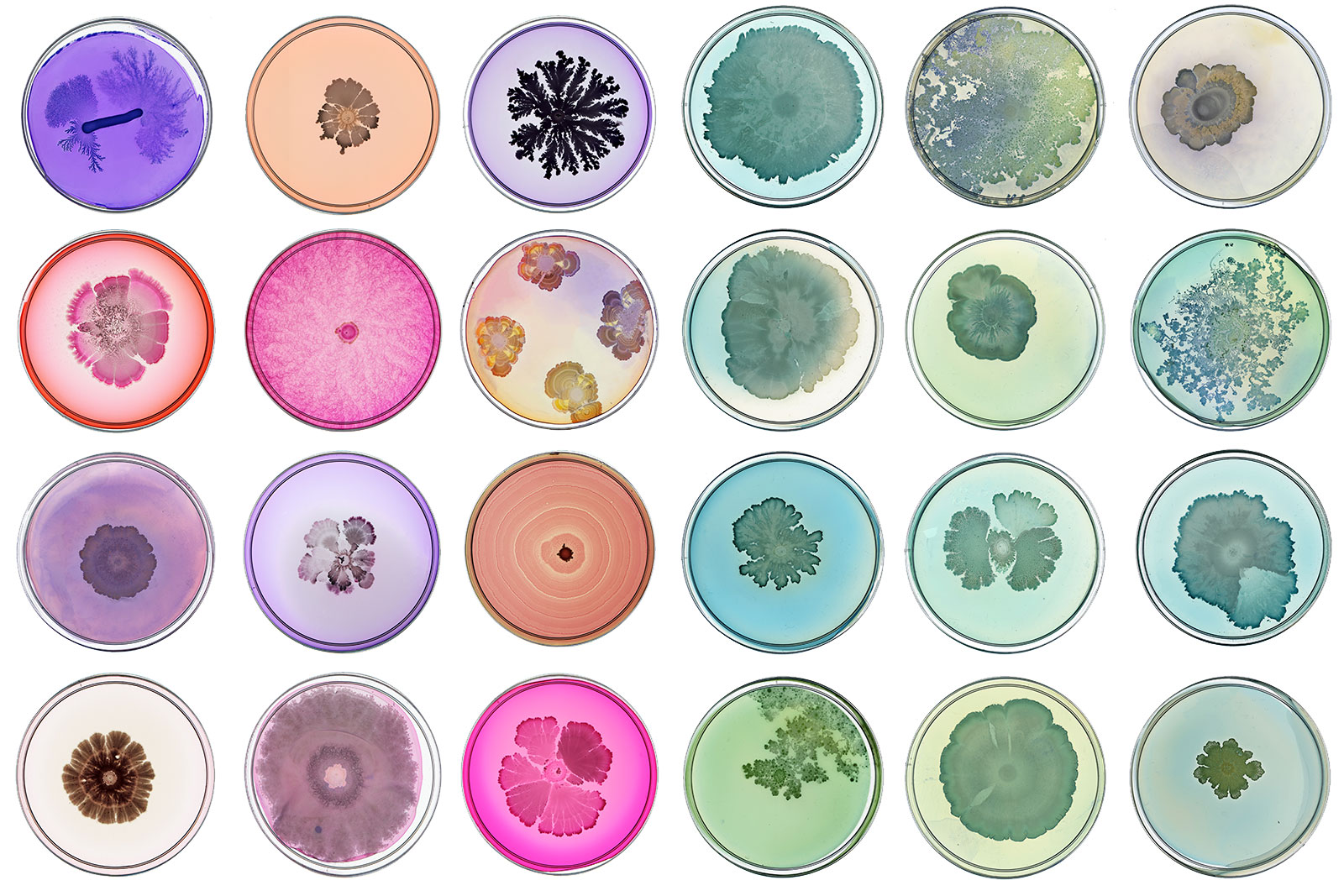
Figure 1: Microbial Rainbow, Tal Danino, 2018. This stunning visual shows the striking characteristics of microbial cultures, grown on petri dishes coated with agar. Danino is researching how to leverage microbes for delivery of cancer-fighting treatments at Columbia University. In an article for Columbia magazine, he explained that “art inspires a lot of the science that we do” and that “the art is about provoking questions about what these little things mean and how they connect to our lives” [1].
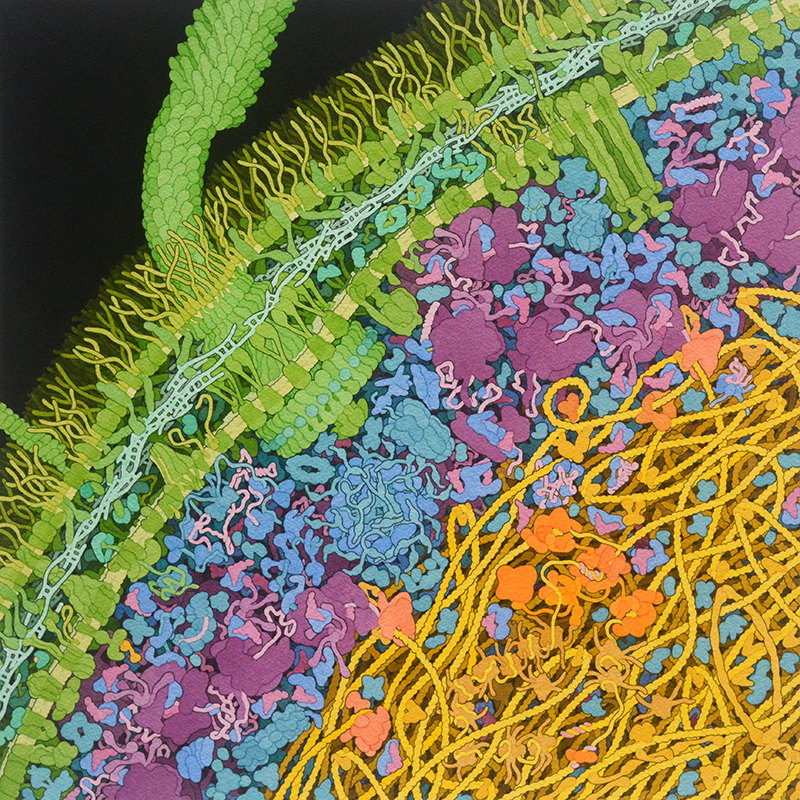
Figure 2: Molecular Landscapes, David S. Goodsell. This is a watercolour painting showing the cross-section of part of an E. coli cell. This illustration was masterfully constructed using scientific data on protein shape and form [3].
Certainty and fact also imply a lack of space for interpretation; after all, doesn’t the data speak for itself? Absolutely not. Consumers of the scientist’s produced work will critique the answer that they have crafted. Many will offer some new perspective that bridges the answers the scientist has posited with their own perception. The scientist has used their technical expertise to explain how they understand a piece of the world. Other scientists with different backgrounds and experiences will glean an alternative meaning in the data. Perhaps science and art are not so polar.
The artist’s brain and way of thinking are prevalent in the world of scientific discovery, but at least today, art itself is not. In the late nineteenth century, being a skilled writer, artist, or performer was essential for convincing peers of the value of your work [4, p. 13]. Today, the success of the scientific researcher largely depends on more empirical beacons of value, such as the experimental design or statistical power. Yes, you need to convey your findings and proposed research as clearly and concisely as possible, but mostly to other scientists who probably already have a certain degree of relevant knowledge. For the most part, you do not need to infuse into your publications the emotion, hope, and humanity that is necessary to win the hearts of people who have had no prior exposure to your scientific niche. Despite this, the actual practice of science is centred around humanity. Every research project we undertake aims to better understand, and perhaps improve, some aspect of the human experience. Yet these human undertones of science are often obscured by bureaucratic hues painted by the professionalisation of scientific discovery. To the general onlooker, science appears to be a conglomerate of complex and inaccessible information sequestered behind paywalls and in the halls of universities and laboratories. That is not much to get excited about. Behind each article published in Nature or Cell, there are a team of researchers with their own stories. There were late nights spent bonding over failed experiments in the break room. Advice and words of encouragement would have been handed out, as well as collective celebration when someone’s work finally went to plan. The scientists behind the jargon and the paywalls will light up when asked about their work and explain with passion how their research might contribute to the greater good. This human side of science is not traditionally advertised. Therefore, qualities of the artist, such as emotion, perception, and creativity so inherent in the pursuit of empirical evidence, are usually not what spring to mind when thinking of the scientist.
We absolutely need strong experimental design and statistical significance to conduct good science, but we should also reject the narrative that science is an emotionless, sterile practice. As genomics researcher Noam Shomron stated for The Journal of Molecular Neuroscience, “Adding a human touch to a scientific paper can make it more relatable, accessible, and inspiring” [5]. By reducing the volume of inaccessible scientific jargon that the layman has to wade through in order to glean any degree of understanding about a new discovery, we open the door to connection. Being able to effectively condense a scientific concept into a simple visual form can amplify this connection further. Take, for example, the result of the collaboration between the microbiologist Dr Siouxsie Wiles and illustrator Toby Morris during the COVID-19 pandemic [6]. Through a series of playful illustrations, the pair were able to clearly and impactfully communicate complex epidemiological concepts in a way that would have meaning for any onlooker.
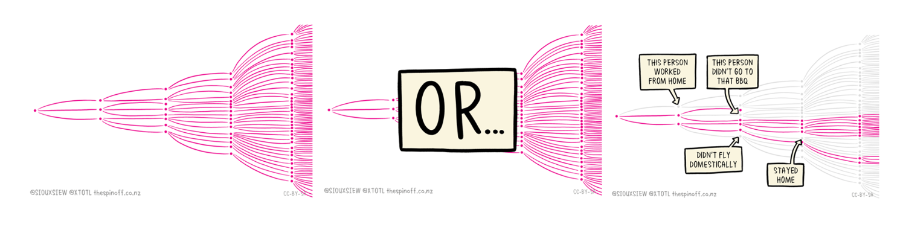
Figure 3: Break the Chain, Toby Morris and Dr Siouxsie Wiles, 2020. This visual aid, which was distributed as an animation, clearly communicates the concept of exponential transmission of SARS-CoV-2. This illustration was used in official health communications around the world and first published in The Spinoff in 2020. Available under the Creative Commons CC-BY-SA-4.0 licence [6].
Science communication is an essential, but often overlooked tool in the age of modern science. However, all too often, science communication is reduced to theory, but at its core successful communication is achieved when you offer information that resonates with the beholder. By sharing the humanity and creativity of scientists through accessible means, such as through art, we can increase the amount of people who can interact with and find meaning in science.
What is art? This question is not easy to answer. Art is, at its core, subjective. It is an experience unique to both the creator and the beholder. The artist draws on their experience to say something about their world. They use their technical understanding of colour, shape, and texture to comment on what it means to be human.
On a sphere of human experience, it may seem that science lies at the antipode of art. The connotations of science include certainty and logic, and do not include emotion and subjectivity. The scientist would beg to differ. There are many cognitive processes common to both science and art [2]. Like the work of an artist, the scientist’s pursuit of knowledge requires imagination, creativity, and vision. They will pose a question about their world. They have an idea about what will happen that may, or may not, be real. They use what they know about the world around them to convert this idea into something tangible that can be shared and exhibited. In vitro, the world unseen and unanswered begins to take shape. Each experiment is a brushstroke on a blank canvas, eliciting some notion about what it means to live and die in this world.
Like an artist, a scientist’s passion for their craft is fuelled by their curiosity about the world around them. They see hidden meaning in what may otherwise seem mundane. I certainly do this myself. Most of what we study in the lab is invisible to the naked eye. However, every time I look at a cell under a microscope, I imagine an anthropomorphic symphony of proteins and chemical compounds dancing in synchrony to keep the cell alive. In every accidental bump and scratch, I see a tango of cytokines, structural proteins, and other wound-healing factors as my skin knits itself back together. In many cases, being a scientist requires the ability to imagine things beyond what is tangible. Therefore, it makes sense that the artist’s brain is better suited to the pursuit of science than stereotypes might have us believe.
[1] Tal Danino Art, Microbial Rainbow, 2018. Accessed: Jan. 13, 2026. [Photo]. Available: https://www.taldaninoart.com/bacteria-gallery-1.
[2] G. Ghisleni, C. Stolte, M. Gozzard, L. V. Soosten, and A. Bruno, “Why science needs art,” Front. Bioinform., vol. 5, Oct. 2025, doi: 10.3389/fbinf.2025.1708311.
[3] D. S. Goodsell, “Art as a tool for science,” Nat. Struct. Mol. Biol., vol. 28, no. 5, pp. 402–403, May 2021, doi: 10.1038/s41594-021-00587-5.
[4] A. Fyfe and B. Lightman, “Science in the Marketplace: An Introduction,” in Science in the Marketplace, A. Fyfe and B. Lightman, Eds., Chicago, IL, USA: University of Chicago Press, 2007.
[5] N. Shomron, “Don’t Devoid Emotions from Science,” J. Mol. Neurosci., vol. 74, no. 4, Jan. 2025, doi: 10.1007/s12031-024-02284-6.
[6] Staff Writers. “The bumper Toby Morris & Siouxsie Wiles Covid-19 box set.” The Spinoff. Accessed: Jan. 15, 2026. [Online]. Available: https://thespinoff.co.nz/media/07-09-2021/the-great-toby-morris-siouxsie-wiles-covid-19-omnibus.

Emily is currently completing a Masters of Biomedical Science, focusing on molecular genetics in the context of human health. Outside the lab, her role as the co-vice president of the Scientific keeps her busy. She also enjoys hiking, photography, painting, and writing.