
The Sitting Problem: How a Sedentary Lifestyle Affects Your Health
Sedentary and Physiology | Jaanvi Jamnadas
Introduction
Sustainable Development Goal 3 (SDG 3) aims to promote health and well-being for people of all ages, including preventing non-communicable diseases linked to sedentary lifestyles.
Think about a typical day as a university student. You may sit while travelling to campus, attending lectures, studying, eating and relaxing in front of a screen. A review of 125 studies found that students spent an average of 7.29 hours per day sedentary based on self-reported behaviour, increasing to 9.82 hours when measured using movement-tracking devices [1]. This shows how easily sitting can occupy most of a student’s day.
Although sitting is a normal part of daily life, research has linked prolonged periods without movement to changes in blood glucose regulation, fat metabolism and blood vessel function [2]. High levels of sedentary behaviour are also associated with an increased risk of cardiovascular disease and type 2 diabetes [3]. Addressing this behaviour therefore supports SDG 3 by helping to prevent disease and promote student well-being.
This article explains what sedentary behaviour is, its effects on the body, whether exercise can reduce these effects, and practical ways students can move more throughout the day.
What Is Sedentary Behaviour?
Sedentary behaviour is generally defined as any waking activity performed while sitting, reclining or lying down that requires no more than 1.5 metabolic equivalents, or METs [4]. One MET represents approximately the amount of energy used by the body at rest. Attending a lecture, studying at a desk, driving and watching television are examples of sedentary behaviour [4]. Sleeping is not included because the definition only applies to time spent awake [4].
Sedentary behaviour is different from physical inactivity. Physical inactivity means that a person does not complete the recommended amount of moderate or vigorous physical activity. Sedentary behaviour refers to the amount of time spent sitting or reclining while using very little energy [4], [5].
This means that someone can exercise regularly and still spend too much time sitting. For example, a student may complete a one hour gym session before spending the rest of the day sitting in lectures, commuting and studying. The gym session provides important benefits, but it may not prevent every physiological response caused by several hours of uninterrupted sitting [2], [5].
Sedentary time is not always a personal choice. University education often requires computer use and extended periods of seated study [1]. Disability, injury, illness and the design of study or transport environments can also affect how often a person is able to move [5].
What Happens to the Body?
Muscle Activity and Blood Glucose
When a person walks, climbs stairs or changes positions, their skeletal muscles contract and use energy. While sitting, the large muscles in the legs remain relatively inactive and use less energy [2]. This reduction in activity affects how the body regulates glucose, uses fats and circulates blood [2].
After a meal, carbohydrates are broken down into glucose. The glucose enters the bloodstream and causes the pancreas to release insulin. Insulin is a hormone that helps cells absorb glucose so it can be used for energy or stored for later [2].
Skeletal muscle is one of the main parts of the body that removes glucose from the blood. Muscle contractions can increase glucose uptake through processes that do not depend entirely on insulin [2]. Moving after eating therefore gives the muscles a reason to use some of the glucose circulating in the blood.
During prolonged sitting, the inactive leg muscles require less glucose. Blood glucose and insulin concentrations may therefore remain elevated for longer after eating [2], [6]. In one controlled experiment, adults completed five hours of uninterrupted sitting. On separate occasions, they interrupted their sitting every 20 minutes with two minutes of light or moderate walking. Both types of walking reduced their glucose and insulin responses after eating [6].
Blood Flow and Blood Vessel Function
Movement also supports circulation. When the leg muscles contract, they compress nearby veins and help move blood back towards the heart. This is known as the skeletal muscle pump [2]. When a person remains seated and still, this pumping action decreases. Blood flow through the legs can decline and blood may collect in the lower limbs [2].
The inside of each blood vessel is lined with endothelial cells. These cells respond to shear stress, which is the friction created as blood moves along the vessel wall. Shear stress stimulates the production of nitric oxide, a molecule that helps blood vessels relax and widen [2].
When prolonged sitting reduces blood flow, it also reduces shear stress. As a result, the arteries in the legs may temporarily become less able to widen [2], [7].
One experiment involved 11 healthy adults who sat for three hours. They moved one leg for one minute every five minutes while keeping the other leg still. The ability of an artery to widen declined in the inactive leg but was maintained in the leg that moved regularly [7]. Figure 1 shows that blood vessel function declined in the inactive leg but was improved in the leg that moved regularly during sitting [7].
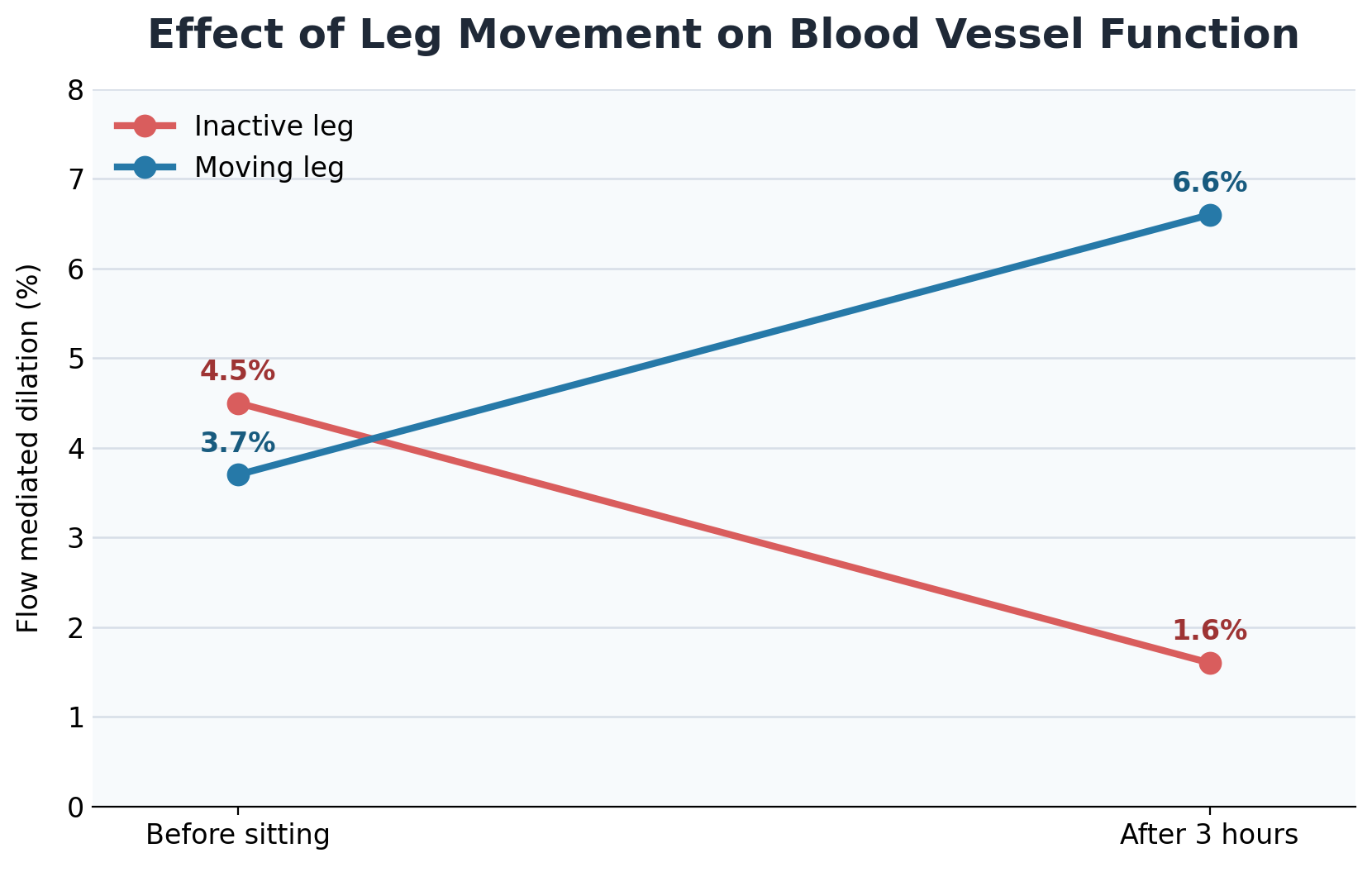
Figure 1: Flow-mediated dilation before and after three hours of sitting. One leg remained inactive, while the other completed regular one minute movements. Data adapted from Morishima et al. [7].
This was a small study that measured an immediate response rather than the development of disease. It does not mean that one long lecture will permanently damage someone’s arteries. However, it demonstrates that blood vessels can respond quickly to movement [7].
Muscles, Joints and Discomfort
Prolonged sitting can also increase physical discomfort. In one experiment, office workers reported increasing discomfort in the neck, shoulders, upper back, lower back and thighs during four hours of sitting [8]. They changed position more often as their discomfort increased, suggesting that the body naturally uses movement to redistribute pressure [8].
There is no single sitting position that prevents all discomfort. The problem may be staying in the same position for too long, rather than failing to sit perfectly upright [8]. Neck and back discomfort can also be influenced by workstation design, previous injuries and individual health. Sitting should therefore not be treated as the only cause of pain [8].
Changing position redistributes pressure and changes which muscles are active. Standing briefly, walking or adjusting the sitting position may be more useful than trying to maintain one posture for several hours [8].
Longer Term Health Risk
Research has associated greater sitting time with higher rates of cardiovascular disease and type 2 diabetes [3]. One analysis examined nine studies involving 448,285 participants. It found that greater daily sitting time remained associated with cardiovascular disease and diabetes even after the researchers considered differences in physical activity [3].
An association does not prove that sitting directly causes these conditions. People who sit more may also differ in their diet, sleep, exercise habits or existing health [3], [9]. Some people may sit more because they already have an illness. This makes it difficult to determine how much of the observed risk is caused by sitting alone [9].
However, different types of evidence support a possible biological connection. Controlled experiments show that prolonged sitting can produce immediate changes in glucose, insulin and blood vessel function [6], [7]. Longer term studies show that people who spend more time sitting experience higher rates of some chronic diseases [3], [9]. Together, these findings suggest that high levels of sedentary behaviour are a relevant health concern, although the risk will differ between individuals [2], [3], [9].
Can Exercise Offset It?
You may think, “I go to the gym, so sitting for the rest of the day should be fine.” Regular exercise provides significant health benefits and can reduce many of the risks associated with sedentary behaviour. However, exercise and movement breaks do not have exactly the same purpose [2], [5].
Structured exercise improves heart and lung fitness, muscular strength and metabolic health [5]. Movement breaks interrupt muscle inactivity and increase blood flow during periods that would otherwise involve continuous sitting [2], [6], [7]. A gym session is valuable, but it does not make the movement pattern of the remaining day irrelevant.
An analysis using information from more than one million adults found that the relationship between sitting time and premature death was weakest among the most physically active participants [10]. This suggests that high levels of physical activity can reduce much of the risk associated with sitting. However, the activity needed to offset very high sitting time was greater than the minimum level achieved by many adults [10].
Practical Student Strategies
Moving more does not mean doing a workout every time you take a study break. The easiest approach is to fit small amounts of movement into activities you already do.
When you finish a lecture or a section of an assignment, get up for a few minutes before starting the next task. Walk to refill your water bottle, visit the bathroom, stretch or do a quick lap of the building. Setting a timer for every 30 to 60 minutes can help if you often lose track of time while studying.
Try standing while reading notes, reviewing flashcards or watching a recorded lecture. If you are taking a casual phone call, walk around instead of remaining seated. You could also place your phone, charger or water bottle away from your desk so you have a reason to get up.
Use the movement opportunities already built into campus life. Walk between university buildings, take the stairs when practical and avoid sitting while waiting for your next class if you have already been seated for a long time. If you commute, consider parking a little farther away or getting off public transport one stop earlier when it is safe and convenient.
Study with friends in a way that encourages movement. You could discuss ideas while walking around campus or take a short group break between study topics. Movement can also be added to leisure time by getting up between television episodes, gaming rounds or videos.
Choose a few ideas that feel realistic instead of trying to change everything at once. A short walk between lectures, a movement break during study and regular exercise each week can be a practical starting point. The goal is simply to avoid remaining completely still for hours at a time.
Conclusion
Sedentary behaviour may be a normal part of university life, but prolonged sitting can negatively affect the body and increase the risk of long-term health conditions. Breaking up sitting time and adding regular movement to everyday routines can help students protect their current and future health.
[1] O. Castro, J. A. Bennie, I. Vergeer, G. Bosselut and S. J. H. Biddle, “How Sedentary Are University Students? A Systematic Review and Meta Analysis,” Prevention Science, vol. 21, no. 3, pp. 332 to 343, 2020, doi: 10.1007/s11121-020-01093-8.
[2] A. J. Pinto et al., “Physiology of Sedentary Behavior,” Physiological Reviews, vol. 103, no. 4, pp. 2561 to 2622, 2023, doi: 10.1152/physrev.00022.2022.
[3] D. P. Bailey, D. J. Hewson, R. B. Champion and S. M. Sayegh, “Sitting Time and Risk of Cardiovascular Disease and Diabetes: A Systematic Review and Meta Analysis,” American Journal of Preventive Medicine, vol. 57, no. 3, pp. 408 to 416, 2019, doi: 10.1016/j.amepre.2019.04.015.
[4] M. S. Tremblay et al., “Sedentary Behavior Research Network Terminology Consensus Project Process and Outcome,” International Journal of Behavioral Nutrition and Physical Activity, vol. 14, art. no. 75, 2017, doi: 10.1186/s12966-017-0525-8.
[5] World Health Organization, WHO Guidelines on Physical Activity and Sedentary Behaviour. Geneva, Switzerland: World Health Organization, 2020. [Online]. Available: https://www.who.int/publications/i/item/9789240015128. [Accessed: 30 Aug 2026].
[6] D. W. Dunstan et al., “Breaking Up Prolonged Sitting Reduces Postprandial Glucose and Insulin Responses,” Diabetes Care, vol. 35, no. 5, pp. 976 to 983, 2012, doi: 10.2337/dc11-1931.
[7] T. Morishima, R. M. Restaino, L. K. Walsh, J. A. Kanaley, P. J. Fadel and J. Padilla, “Prolonged Sitting Induced Leg Endothelial Dysfunction Is Prevented by Fidgeting,” American Journal of Physiology: Heart and Circulatory Physiology, vol. 311, no. 1, pp. H177 to H182, 2016, doi: 10.1152/ajpheart.00297.2016.
[8] P. Waongenngarm, A. J. van der Beek, N. Akkarakittichoke and P. Janwantanakul, “Perceived Musculoskeletal Discomfort and Its Association With Postural Shifts During Four Hour Prolonged Sitting in Office Workers,” Applied Ergonomics, vol. 89, art. no. 103225, 2020, doi: 10.1016/j.apergo.2020.103225.
[9] J. Wu et al., “Sedentary Behavior Patterns and the Risk of Noncommunicable Diseases and All Cause Mortality: A Systematic Review and Meta Analysis,” International Journal of Nursing Studies, vol. 146, art. no. 104563, 2023, doi: 10.1016/j.ijnurstu.2023.104563.
[10] U. Ekelund et al., “Does Physical Activity Attenuate, or Even Eliminate, the Detrimental Association of Sitting Time With Mortality? A Harmonised Meta Analysis of Data From More Than One Million Men and Women,” The Lancet, vol. 388, no. 10051, pp. 1302 to 1310, 2016, doi: 10.1016/S0140-6736(16)30370-1.

Jaanvi Jamnadas- Bachelor of Commerce / Bachelor of Science Conjoint (BCom/BSc)
Jaanvi is a final year Bachelor of Commerce and Bachelor of Science conjoint student. She enjoys learning about topics beyond her fields of study, which helps her stay curious and open minded. Her interests include health, sustainability, technology, and understanding how research connects with people’s everyday lives.