
How to Make Walkie Talkies Out of Salt: The Chemical Composition and Mechanical Applications of the Piezoelectric Effect Using Rochelle Salts
Materials science and physical chemistry| Cassandra Caldera
Introduction
Dr Stone is an anime about humans having to restart from the stone age due to an extinction-level event. A particular episode within the show features a scene where the protagonist, Senku, gives his friend Kohaku a crystal wrapped in copper wire termed a “Rochelle salt” to use as an earpiece. Notably, these friends are surviving in the stone age and have no access to modern-day electronics. Yet, they have been trying to rebuild civilization from scratch, and part of their mission to reach this goal involved establishing long distance communication through these crystals. Senku—speaking into his Rochelle salt—and Kohaku hearing it over hers, demonstrate that these crystals have the capacity to function as both a microphone and a speaker in the stone age. This raises a fundamental question, how can sound be transmitted between two people over vast distances with Rochelle salts? Intuitively, it may seem as though sound waves are simply travelling through air, and miraculously being captured by the crystals, but the process is far more nuanced.
History
Rochelle salts are not minerals, stones, or something naturally produced by the environment. They were discovered way back in the 17th century, by Pierre Seignette in La Rochelle, France. Seignette saw deposits of crude tartar, most likely in the barrels of winemaking. This observation led him to neutralise potassium bitartrate (cream of tartar), by reacting it with sodium carbonate, creating a “double salt.” Soon afterwards, this ferroelectric crystal became known as the “Rochelle salt.” The answer to how Rochelle salts can essentially form “walkie-talkies” lies in a property known as the piezoelectric effect, which allows sound to be converted into electrical signals through some elegant mechanical physics at the molecular level [1].
Understanding the Chemical Properties of Rochelle Salts
In order to understand how rochelle salts form the basis of communication, we need to understand what they are made of, and their chemical properties. The scientific name for rochelle salts is sodium potassium tartrate tetrahydrate: KNaC₄H₄O₆·4H₂O [2]. As we said before, Rochelle salts are neither minerals nor stones, nor can they be mined out while spelunking in nature’s caves; they can only be chemically synthesised into existence, or even produced at home. Cream of tartar is stirred in hot water, and washing soda is added into the mix bit by bit. The water forms the tetrahydrate component of a Rochelle salt unit. This concoction is then run through filter paper into a container. The container is then covered to protect it from sunlight and dust, and evaporation occurs over a period of time. When the liquid in the container cools, Rochelle salts pop into existence. The reaction between cream of tartar (potassium bitartrate) and washing soda (sodium carbonate) yields our Rochelle salt. This process is termed an acid base neutralisation [3]. Potassium bitartrate has one acidic H+, so when potassium bitartrate donates its H+ to the carbonate base of washing soda, CO2 and H2O form. Eventually, a double displacement reaction (also known as metathesis) occurs [4]. The ions, sodium (Na+) and potassium (K+), redistribute themselves around the tartrate ion, resulting in a mixed salt (Na⁺ + K⁺ with tartrate2⁻). Tartrate initially has a 2-charge (meaning it has lost two protons) and will thus become a dianion. Our tartrate dianion will then bond ionically with Na+ and K+; these ions will neutralise the charge of the tartrate unit and stabilize the crystal, thus forming the sodium potassium tartrate unit [5]. Below is a diagram that shows the formation of the sodium potassium tartrate tetrahydrate unit of a rochelle salt. These units repeat and repeat in a regular 3D arrangement to form a lattice, which is why the rochelle salt has a clear crystalline structure.
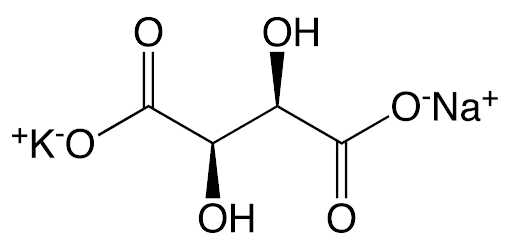
Figure 1: Skeletal formula of sodium potassium tartrate
Now, we know Rochelle salts form a lattice, which is a repeated, ordered symmetrical framework of the units in the diagram above, but it must also be mentioned that the units of these structures are hydrated; specifically, it is a tetrahydrate [3]. That is why it was essential to mix the water with the tartrate, as that is what builds water molecules into the crystal. The function of the water molecules is to help space out the ions evenly and stabilize the lattice [4]; this is essential for the piezoelectric properties of the Rochelle salt.
With our newly made crystals, we must test them for piezoelectricity. In order to do this it is important to understand what the piezoelectric effect is, and how the chemical composition of rochelle salts allow this effect to exist.
Rochelle salts and Piezoelectricity
Rochelle salts have been studied for their piezoelectric effects for a long time. Piezoelectricity simply means being able to generate electricity through applied mechanical stress. When mechanical stress is applied to piezoelectric crystals, a voltage is generated [6], as shown in Figure 2.
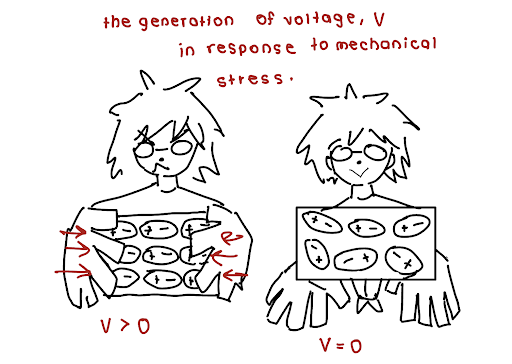
Figure 2: Drawing depicting the effect of applying mechanical stress on a Rochelle salt (left) lattice as opposed to the Rochelle salt in its resting state (right)
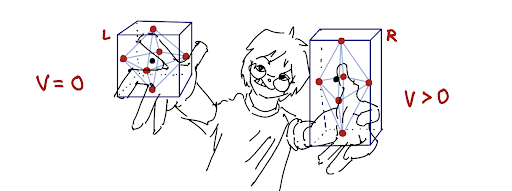
Figure 3: Drawing depicting a non-piezoelectric material with a centre of symmetry (left) and a piezoelectric material without a centre of symmetry (right)
Piezoelectric materials cannot have a centre of symmetry [7]. In Figure 3, on the left, is the non-piezoelectric unit, identifiable by its centre of symmetry. On the non-piezoelectric side, the central atom sits right in the middle, and the surrounding atoms are evenly spaced. As a result, the whole structure is centrosymmetric (mirrored, balanced), this causes any charges to cancel out and the symmetrical structure puts it at a state where it experiences minimal electrostatic repulsions [6].
On the piezoelectric side (right), the central atom has shifted slightly off-centre. Now one side of the unit has a little more positive charge and the opposite side has a little more negative charge. This imbalance creates a polarisation, or a separation of charge within the unit. The uneven charge is what creates the voltage [8].
This means in piezoelectric crystals, the unit cell is slightly asymmetrical, so what you’ll be seeing throughout a lattice of a Rochelle salt would be the unit cell on the right. The positive and negative charge centres do not line up exactly, meaning each unit cell has a tiny electric dipole (a small separation of positive and negative charge). When stress is applied to a Rochelle salt, the atoms physically shift relative to each other. The lattice is asymmetrical, so the shift increases or decreases the separation between the oppositely charged centers, and as a result these tiny electric dipoles change. This is happening across billions of dipoles and if we imagine them all aligning, the whole crystal’s surface develops a net polarisation (buildup of positive charges on one face and negative on opposite face), creating an electric potential across the crystal [6].
Thus, if mechanical force is applied to this Rochelle salt by squeezing it, and the faces of a Rochelle salt are connected with a wire, this will create a potential difference where one side is positive, and the other side is negative. If you connect a wire either side of the Rochelle salt (one end is connected to the side that’s positive, and the other end connected to the negative side), then the electrons will flow through the wire to balance the charge difference.
The Walkie Talkies
As we mentioned before, the Rochelle salt was wrapped in a coil of copper wire. During their distant communication, Senku had to carry around a metallic bulky box with antennae while speaking to Kohaku through this Rochelle salt. The metallic box almost certainly hides a stone-age oscillator and modulator circuit. An oscillator circuit is an electronic circuit that produces a stable repeating waveform without needing an input signal [9], and a modulator, alters a carrier signal from an oscillator using audio or data [10]. The oscillator (the object making the consistent sound) in Senku’s box makes a high-frequency AC carrier: a rapidly oscillating current that switches between the positive and negative terminals of a wire. Essentially, imagine electrons jiggling back and forth across a wire instead of actually moving across it [9]. If Senku spoke into his Rochelle salt microphone without the oscillator and modulator, the Rochelle salt microphone on its own would emit frequencies too low for efficient radiation. A high frequency wave can radiate well from antennas, so that is why a high frequency AC carrier is used. The modulator “imprints” Senku’s audio signal onto that carrier. Therefore, after Senku has spoken into his Rochelle salt microphone, his voice creates a voltage on the crystal that matches his waveform, the sound waves compress and stretch the Rochelle salt crystal, inducing the piezoelectric effect, and creating a voltage (caused by net polarization) that matches his voice waveform. This voltage drives a current in the coil of wire, and the current in the coil oscillates in sync with his voice. The oscillating current basically creates radio waves. The coil and attached antenna radiate these radio waves into the air, allowing them to travel a long distance and fly through space. Kohaku’s earpiece has a Rochelle salt wrapped in a coil of wire. Together this setup forms a crude receiver circuit that accepts Senku’s sound waves. As a result, the salt crystal earpiece acts as a speaker through a reverse piezoelectric effect. On Kohaku’s end, it induces a voltage and makes the crystal expand and contract in sync with the signal, the tiny vibrations shake the thin plate pressed against her ear, and this creates sound waves, Kohaku as a result can hear Senku’s exact words.
References
[1] Q. He, Y. Liang, J. Jian, A. Rajagopalan, D. Kassab, S. Duron, and Y. Yang, "Mechanical behavior and piezoelectric potential of 3D-printed bouligand structures with Rochelle salt," in Proc. ASME Int. Manuf. Sci. Eng. Conf. (MSEC2026), State College, PA, USA, Jun. 2026.
[2] A. Andrusyk, "Piezoelectric effect in Rochelle salt," 2011. [Online]. Available: https://doi.org/10.13140/2.1.4242.0168.
[3] A. M. Helmenstine, "How to make Rochelle salt (sodium potassium tartrate tetrahydrate)," Science Notes, [Online]. Available: https://sciencenotes.org/how-to-make-rochelle-salt-sodium-potassium-tartrate-tetrahydrate/.
[4] C. A. Beevers and W. Hughes, "The crystal structure of Rochelle salt (sodium potassium tartrate tetrahydrate NaKC₄H₄O₆·4H₂O)," Proc. Royal Soc. A, vol. 177, pp. 251-259, 1941.
[5] F. Mo, R. H. Mathiesen, J. A. Beukes, and K. M. Vu, "Rochelle salt- a structural reinvestigation with improved tools. I. The high-temperature paraelectric phase at 308 K," Acta Crystallogr. B, vol. 71, no. 1, pp. 17-26, Feb. 2015. doi: 10.1107/S2052520614024438.
[6] D. Damjanovic, "Contributions to the piezoelectric effect in ferroelectric single crystals and ceramics," J. Am. Ceram. Soc., vol. 88, no. 10, pp. 2663-2676, 2005. doi: 10.1111/j.1551-2916.2005.00671.x.
[7] R. Sadanaga, "The crystal structure of potassium sodium dl-tartrate tetrahydrate, KNaC₄H₄O₆·4H₂O," Acta Crystallogr., vol. 3, no. 6, pp. 416-423, 1950.
[8] R. Styrkowiec, "The interaction between moving domain walls in Rochelle salt crystals," Phys. Status Solidi A, vol. 87, no. 2, pp. K135-K138, 1985. doi: 10.1002/pssa.2210870246.
[9] M. Carpentieri and G. Finocchio, "Spintronic oscillators based on spin-transfer torque and spin-orbit torque," in Handbook of Surface Science, Amsterdam, Netherlands: Elsevier, 2015, pp. 297-334. doi: 10.1016/b978-0-444-62634-9.00007-2.
[10] A. Akan and L. F. Chaparro, "Frequency analysis: The Fourier transform," in Signals and Systems with MATLAB Applications, Amsterdam, Netherlands: Elsevier, 2024, pp. 355-448. doi: 10.1016/b978-0-44-315709-7.00015-x.

Cassandra Caldera is currently a second year biomedical student specialising in neuroscience. The idea of creating modern-day technology from scratch intrigued and inspired her to write this article. Aside from academia, her pastimes are sketching, breakdancing, and playing piano.