
Majorana 1: The Pursuit and Controversies of Quantum Computing
Quantum Computing | Aimee Lew
Quantum computing is considered one of the frontiers of scientific advancement. It is expected to provide exponential efficiency gains over classical computing in some applications, particularly in simulating quantum systems for chemical, materials, and pharmaceutical development. Quantum computing is where advanced scientific research clashes with governments and Big Tech, leading to tensions between academic ethics and commercial practices. Microsoft’s quantum research team behind their topological core quantum computing processor, Majorana 1, is one case study of how market pressures can supersede traditional attitudes like transparency, integrity, and objectivity.
The Pursuit
The difficulty in quantum computing lies in its scale. Classical computing uses circuitry, voltages, and tiny electronic components inside our laptops and smartphones. Quantum computing takes place at the scale of atoms and subatomic particles. Instead of storing information as electrical charges laid on a thin capacitor (your familiar ones and zeroes), information is stored in systems as small as the excitations of electrons in an atom. To the human eye these are both miniscule systems, but there are orders of magnitude between them. Quantum systems are incredibly susceptible to noise and perturbations caused by measurement, the necessary act for extracting computing information from the qubits.
To be scalable, quantum computing needs to solve the noise problem, which emerges from temperature variations, magnetic fields, and errant vibrations. Research teams seek to reduce error and improve noise tolerance in quantum computers (QCs) by way of superconductors, spintronics, trapped-ion QCs, and neutral atom QCs, to name a few. QCs do already exist, with limited (generally under 50) qubits and non-trivial susceptibility to noise. A QC will only be revolutionary if it can host a large number of qubits, as many as one million.
Microsoft is pursuing large-scale quantum computing via topological superconductors [1]. Their research team is led by physicist and quantum computer scientist Chetan Nayak. Topological quantum computing in theory would scale much easier than competing methods because they use a type of particle called an anyon. Anyons have the special property that exchanging two identical particles twice leaves their wave functions altered. In contrast, bosons and fermions have the property that exchanging two identical particles twice leaves both their wave functions the same as at the beginning; if you swap them once, then swap them back, it is impossible to detect whether they were exchanged at all [2]. It is therefore possible to create quantum braids in spacetime with anyons just by shifting their positions in a material. These braids hold a historical record of the operations that were performed [3].
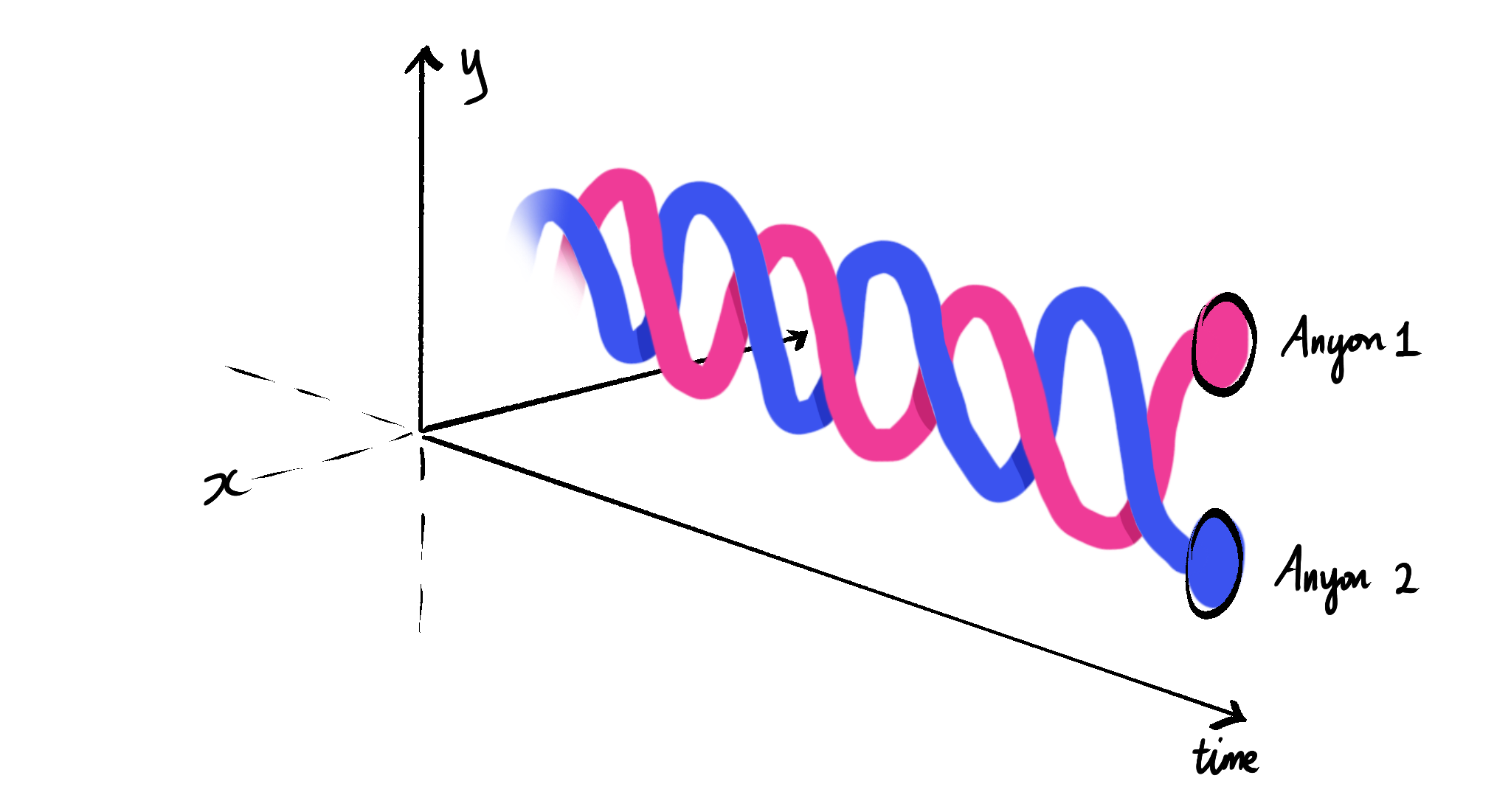
Figure 1: Exchanging two identical anyons to form a quantum braid in spacetime. Illustration by the author.
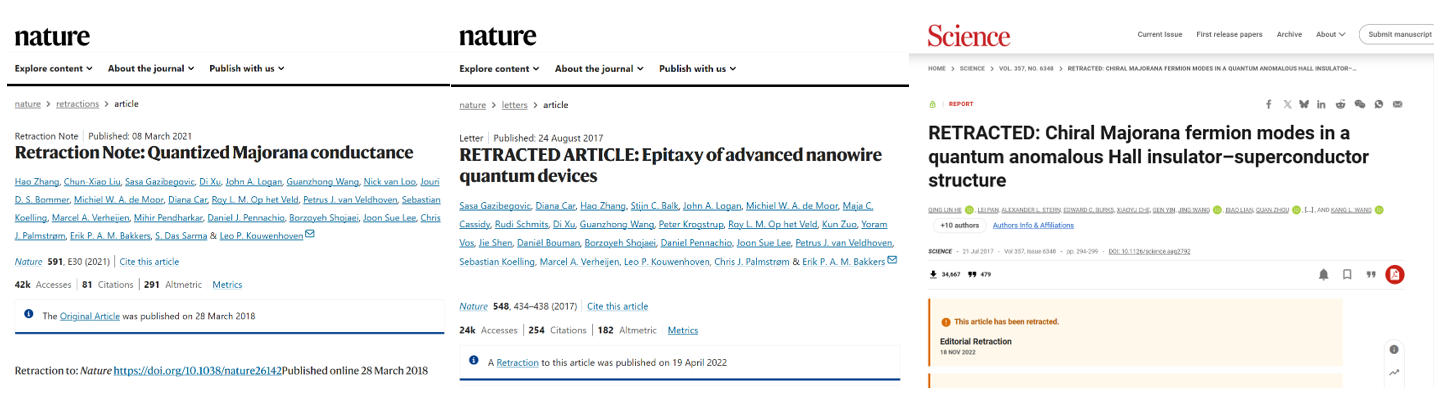
Figure 2: Majorana articles, published 2017–2018, that were retracted in 2021–2022 [7]–[9].
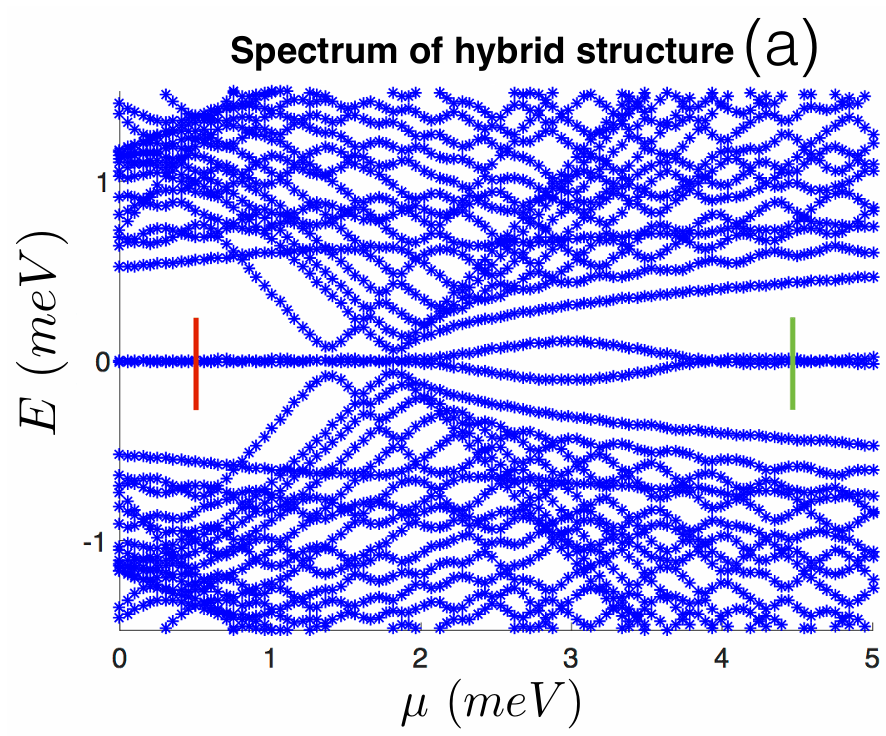
Figure 3: Simulated energy E spectrum of a semiconductor-superconductor structure as a function of chemical potential μ. The red line indicates the topological regime where MZMs occur. The green line indicates the non-topological regime where ABSs occur [10, Fig. 11(a)].
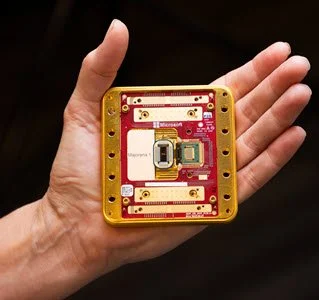
Figure 4: The Majorana 1 quantum chip [11].
Glossary
Andreev bound state: a superposed quantum state consisting of an electron and a hole (absence of particle). They can evolve into Majorana zero modes but are not themselves zero-energy or topologically protected.
Boson: a particle with integer spin (intrinsic angular momentum), which can act as a qubit.
Conductance: a measurement of conductivity, how well a material conducts electricity.
Fermion: a particle with half-integer spin (intrinsic angular momentum), which can act as a qubit.
Qubit: the ‘quantum bit’, analogous to the classical bit, the most basic unit of quantum information.
Semiconductor: a material with electrical conductivity between that of an insulator (no conductivity) and a superconductor (high conductivity).
Spacetime: a coordinate system that weaves a time dimension together with spatial dimensions.
Spintronics: from ‘spin transport electronics’; using the spin-up and spin-down states of an electron as a qubit.
Superconductor: a material that conducts electricity with no resistance when cooled below a critical temperature threshold.
Topological: relating to topology, the study of abstract shapes and their properties.
Wave function: an equation that describes the state of a quantum system.
Zero energy: the minimum energy a quantum system can possess.
When a Majorana fermion—a particle that is its own antiparticle and the namesake of Microsoft’s quantum computing research team—is bound at zero energy to the ends of a superconducting wire, the bound system together is called a Majorana zero mode (MZM) [4]. MZMs do not exist in nature and need to be coaxed into being via delicate electrical and chemical manipulations. MZMs are anyons, exhibiting quantum braiding behaviour. QCs using this type of topological state are significantly more noise-tolerant than standard QCs [5]. In standard QCs, repeated noise will eventually introduce large errors. In a topological QC, repeated noise has the effect of flexing and bending the braid, which doesn’t change the patterns or links in the braid itself. Thus information, even a million qubits of information, can be protected from the ever-present noise in the quantum world.
But no one has proved that MZMs even exist. Their existence has only been proven mathematically, i.e., they could exist within the current frameworks of particle physics, but not physically.
The lack of proof is not for lack of effort. MZMs enjoy much attention from solid state physicists because of the millions of dollars invested into their application as qubits. It’s precisely because of the monetary and academic investment in this area that the race has sped up and mistakes have been made.
The Controversies
In March 2018, researchers from Microsoft and QuTech (Delft University of Technology’s quantum research group in the Netherlands) collaborated to publish an article in Nature claiming they had found evidence of MZMs [6]. The alleged evidence lay in a conductance measurement from experimental data that was purportedly a signature of MZMs. Physicists Sergey Frolov and Vincent Mourik highlighted inconsistencies between the published figures and the raw data that had been provided to them. The authors then acknowledged that data for two of the figures had been over-corrected and one figure axis was mislabelled, invalidating their conclusion. The article was retracted in March 2021 [7]. In 2022, Nature would go on to retract another Majorana article, which had researchers at QuTech among its authors [8]. Also in 2022, Science retracted a Majorana article written by an international network of authors, primarily from Stanford and the University of California system [9].
Perhaps due to the heightened media attention and scientific skepticism, Majorana-related articles have since been published with more caveats and cautious wording about the significance of results. All the usual challenges of experimental design apply in the search for MZMs, but here I will raise a Majorana-specific difficulty: the Andreev bound states (ABSs). ABSs can look exactly like MZMs in conductance measurements [10]. Distinguishing by experiment an almost-zero-energy Andreev bound state from a zero-energy Majorana bound state is itself an active area of research. A trivial ABS is non-topological, so does not exhibit quantum braiding, and therefore is unable to support large-scale quantum computing.
In February 2025, Microsoft published an announcement that they had developed “the world’s first topoconductor, a breakthrough type of material which can observe and control Majorana particles” [11]. The announcement was accompanied by a same-day Nature journal article and news report. The news report emphasised skepticism from physicists in the field [12]. While the journal article contained experiment schematics [13], accompanying data was not made public. There was no demonstration that their measurements were indeed from the MZM and not something else, like the trivial ABS. Microsoft caveats in [11] that the published measurements “do not, by themselves, determine whether the low-energy states detected by interferometry are topological.”
Nayak promised to share detailed qubit data at an American Physical Society meeting that took place in March 2025. Sergey Frolov and Vincent Mourik, the physicists whose concerns led to the 2021 Nature retraction, were transmitted the slide data and afterwards released a dissenting co-written statement [14]: “It is impossible from a physics point of view that Microsoft has demonstrated a topological qubit.” Low data and equipment quality, erroneous methods, and logical fallacies in Microsoft’s claims are all cited by Frolov and Mourik as contributing factors. Their physics-based criticisms “have been established in the scientific literature going back to 2014. It is impossible for Microsoft to not be aware of them.”
The Implications
The multiple Majorana retractions take place against a backdrop of a very divided field and increasingly frequent retractions across all of academia. The upward trend in retractions has been well documented [15]. Proposed explanations include increases in fraud, plagiarism, and AI; better technologies for detecting scientific misconduct; lower barriers to entry as publishers compete with each other; and the ‘publish-or-perish’ priority on output volume [16]. All of these pressures reduce the quality of scientific articles.
However, prestigious journals like Nature and Science should have ample submissions to pick from and abundant peer reviewers to catch subpar articles. Perhaps the cachet of the Majorana 1 team—flush with talent, repute, and funding—is what incentivises big-name journals to publish. If they don’t publish Microsoft, another journal inevitably will and subsequently reap the attention. High impact journals recognise the prestige of Microsoft’s quantum computing researchers, despite intense debate and division.
The peer review document from Microsoft’s February 2025 article is public, demonstrating the differences of opinion. All reviewers agreed that the article was not a yes/no answer to the Majorana question, but disagreed about whether that left any other merits worth publishing. Two reviewers thought that the measurement method used by the Majorana 1 team was itself novel and worthy of Nature. Another said the result was merely a benchmark that is already standard practice in the literature: “On a technical level, I already acknowledged a certain level of advance, but I estimated it well below the bar for publication in a high-impact journal like Nature.” Eventually, the article was published with support from two out of four reviewers [17].
The Majorana 1 team’s guardedness around their experimental data could be out of their control and more about Microsoft protecting their competitive edge. Nayak said the team is “committed to open publication of our research results in a timely manner while also protecting the company’s IP” [11]. The first quantum computer will most likely be introduced to the world as a saleable product, not a knowledge share for giddy physicists. The smart business manoeuvre is to withhold certain details that would allow other scientists to verify (i.e., reproduce) Microsoft’s results.
This is an uncomfortable tension for many researchers in industry. Traditionally, the spirit of academia has promoted transparency, honesty, and reproducibility. In the physical sciences, reproducibility is especially important to rule out the interference of undisclosed or uncontrolled variables. In 2023, Majorana 1 researchers had to negotiate during the review process about the amount of information they were disclosing in order to successfully publish in Physical Review B. “The intellectual property of the authors' employer has prevented the release of some parameters of the studied devices that may be needed in order to reproduce them,” the journal put out in a subsequent editorial [18]. “As a reflection of the traditional values of the scholarly community, this is not in accordance with the usual norms of the Physical Review journals.”
The problem lies not just with Microsoft, but in an environment where research is dispersing away from universities and toward startups, companies, and governments. When science is protected as a trade secret or classified information, how should we proceed as researchers, publishers, and consumers? Microsoft could very well release the first large-scale quantum computer without releasing the details needed to verify or reproduce the work. Does the ‘how’ matter if the tech just works? To what extent is that good science? We already witnessed a loss of transparency once a novel technology entered the market. OpenAI, the makers of ChatGPT, began as a non-profit organisation seeking to ensure that AI benefits all of humanity. Its models preceding and including GPT-2 were open source. In 2019, the organisation transitioned to a for-profit model and made their subsequent models proprietary. Openness earns trust, but closedness earns profit.
Solid state physicists, Nature, and the Majorana 1 researchers themselves have all stated in one way or another that there is no evidence they have observed MZMs [13]. Microsoft’s statements in [11]—that the “Nature paper marks peer-reviewed confirmation that Microsoft has…been able to create Majorana particles”—is exaggerated at best, fraudulent at worst. Some attach the misleading statements to a bad PR attempt at communicating science, others to stock market manipulation amid a slump in progress. As with the concerns about artificial intelligence overvaluation, it should be noted that quantum computing gains are also consistently over-estimated. For all but a few select applications, like quantum simulation, cryptography, and large-number factorisations, classical computing remains more reliable and practical. Quantum computing requires such refined materials and controlled conditions (most superconducting QCs operate at temperatures colder than deep space) that solving only particular problems can even justify the expense.
The Majorana 1 case study typifies the friction between tech research teams and Big Tech. Competing interests dilute the quality of published work. When intellectual property rights intrude, they threaten traditional scientific norms of transparency and openness. If the project is also a product, advertising takes precedence over objectivity. By impacting publishing, collaboration, funding, and public trust, the sprint to build the first usable quantum computer will only lengthen if these basic scientific principles are forgotten.
[1] Microsoft. “Introducing Microsoft Majorana 1.” news.microsoft.com. Accessed: Mar. 18, 2025. [Online]. Available: https://news.microsoft.com/azure-quantum/.
[2] K. Shtengel, “A home for anyon?,” Nat. Phys., vol. 3, no. 11, p. 763–763, Nov. 2007, doi: https://doi.org/10.1038/nphys767
[3] A. Y. Kitaev, “Fault-tolerant quantum computation by anyons,” Ann. Phys., vol. 303, no. 1, pp. 2–30, Jan. 2003, doi: https://doi.org/10.1016/S0003-4916(02)00018-0.
[4] A. Y. Kitaev, “Unpaired Majorana fermions in quantum wires,” Phys.-Uspekhi, vol. 44, no. 10 suppl., pp. s131–s136, Oct. 2001, doi: https://doi.org/10.1070/1063-7869/44/10s/s29.
[5] C. Nayak, S. H. Simon, A. Stern, M. Freedman, and S. Das Sarma, “Non-Abelian anyons and topological quantum computation,” Rev. Mod. Phys., vol. 80, no. 3, pp. 1083–1159, Sep. 2008, doi: https://doi.org/10.1103/revmodphys.80.1083.
[6] H. Zhang et al., “RETRACTED ARTICLE: Quantized Majorana conductance,” Nature, vol. 556, no. 7699, pp. 74–79, Mar. 2018, doi: https://doi.org/10.1038/nature26142.
[7] H. Zhang et al., “Retraction Note: Quantized Majorana conductance,” Nature, vol. 591, no. 7851, p. E30, Mar. 2021, doi: https://doi.org/10.1038/s41586-021-03373-x.
[8] S. Gazibegovic et al., “RETRACTED ARTICLE: Epitaxy of advanced nanowire quantum devices,” Nature, vol. 548, no. 7668, pp. 434–438, Aug. 2017, doi: https://doi.org/10.1038/nature23468.
[9] Q. L. He et al., “RETRACTED: Chiral Majorana fermion modes in a quantum anomalous Hall insulator–superconductor structure,” Science, vol. 357, no. 6348, pp. 294–299, July 2017, doi: https://doi.org/10.1126/science.aag2792.
[10] C.-X. Liu, J. D. Sau, T. D. Stanescu, and S. Das Sarma, “Andreev bound states versus Majorana bound states in quantum dot-nanowire-superconductor hybrid structures: Trivial versus topological zero-bias conductance peaks,” Phys. Rev. B, vol. 96, no. 7, Aug. 2017, doi: https://doi.org/10.1103/physrevb.96.075161.
[11] C. Bolgar. “Microsoft’s Majorana 1 chip carves new path for quantum computing.” Microsoft Source. Accessed: Jan. 14, 2026. [Online]. Available: https://news.microsoft.com/source/features/ai/microsofts-majorana-1-chip-carves-new-path-for-quantum-computing/.
[12] D. Castelvecchi, “Microsoft claims quantum-computing breakthrough — but some physicists are sceptical,” Nature, vol. 638, no. 872, Feb. 2025, doi: https://doi.org/10.1038/d41586-025-00527-z.
[13] M. Aghaee et al., “Interferometric single-shot parity measurement in InAs–Al hybrid devices,” Nature, vol. 638, no. 8051, pp. 651–655, Feb. 2025, doi: https://doi.org/10.1038/s41586-024-08445-2.
[14] S. Frolov and V. Mourik. “Nayak talk comments APS MM 25.” LinkedIn. Accessed: Jan. 14, 2026. [Online]. Available: https://www.linkedin.com/posts/vincent-mourik-8188379_comments-on-microsoft-qubit-claims-aps-mm-activity-7307793712217030658-BN4M?utm_source=li_share&utm_content=feedcontent&utm_medium=g_dt_web&utm_campaign=copy.
[15] R. Van Noorden, “More than 10,000 research papers were retracted in 2023 — a new record,” Nature, vol. 624, pp. 479–481, Dec. 2023, doi: https://doi.org/10.1038/d41586-023-03974-8.
[16] M. L. Grieneisen and M. Zhang, “A Comprehensive Survey of Retracted Articles from the Scholarly Literature,” PLoS ONE, vol. 7, no. 10, p. e44118, Oct. 2012, doi: https://doi.org/10.1371/journal.pone.0044118.
[17] “Peer Review File: Interferometric Single-Shot Parity Measurement in InAs-Al Hybrid Devices.” Nature Portfolio. Accessed: Jan. 14, 2026. [Online]. Available: https://static-content.springer.com/esm/art%3A10.1038%2Fs41586-024-08445-2/MediaObjects/41586_2024_8445_MOESM2_ESM.pdf.
[18] R. D. Kamien, J. Thomas, S. E. Nagler, A. M. Begley, and S. Kancharla, “Editorial: Transparency in Physical Review Articles,” Phys. Rev. B, vol. 107, no. 21, June 2023, doi: https://doi.org/10.1103/physrevb.107.210001.

Aimee is a final-year Masters student, researching saltwater intrusion into coastal aquifers in the Pacific Islands. Her undergraduate background was in Physics and Politics & International Relations. Outside of academics and serving as the Creative Director of UoA Scientific, she enjoys reading, writing, and visual art.