
Too Small to See, Too Big to Ignore: Microplastics in Aotearoa’s Waterways
Microplastics, Waterways| Haeun Kang
A Familiar Villain in an Unfamiliar Place
Picture the last time you stood at one of Auckland’s beaches: Tāmaki Estuary, perhaps, or the shore of the Waitematā Harbour. The water might have looked clear, inviting, even. But looks can be deceiving. Floating invisibly around you, too small to see with the naked eye, would have been thousands of tiny plastic particles known as microplastics. These particles are now found in every major waterway in Aotearoa New Zealand, from alpine lakes to urban streams and the deep ocean floor. And despite our country’s clean, green reputation, concentrations in Auckland’s streams match those found in rivers running through some of the most densely populated cities in the world [1].
So how did we get here, and what does it mean? To understand the microplastics crisis, we first need to understand plastic itself.
What Is Plastic, and Why Won’t It Go Away?
Plastic is a synthetic material made from long chains of molecules called polymers. These chains are typically derived from fossil fuels (oil and natural gas) and are engineered to be incredibly durable, lightweight, and cheap to produce. These same properties that make plastic so useful in everyday life also make it a persistent environmental problem: plastic does not biodegrade the way organic materials do. Instead, it breaks down physically, fragmenting into ever smaller pieces under the influence of sunlight, heat, and mechanical force, while the polymer chains themselves remain largely intact, sometimes for hundreds of years.
Since mass plastic production began in the 1950s, humans have produced over 9 billion tonnes of plastic. Less than 10% has been recycled [2]. The rest has been incinerated, landfilled, or leaked into the environment. And once plastic is in the environment, the clock does not stop. It keeps breaking down, getting smaller and smaller.
What Are Microplastics?
Microplastics are defined as plastic particles smaller than 5 millimetres in their longest dimension [3]. To put that into perspective, 5 millimetres is roughly the size of a sesame seed. But microplastics can be far smaller. Some are invisible without a microscope, while the related category of nanoplastics describes pieces measuring less than 1 micrometre, smaller than many bacteria.
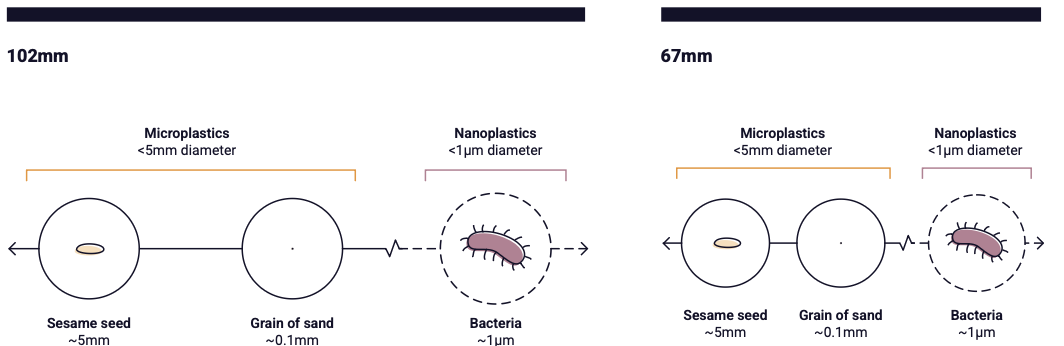
Figure 1: Relative size of microplastics.
Scientists classify microplastics into two main types. Primary microplastics are manufactured to be small from the outset. These include the tiny plastic pellets (called nurdles) used as raw material in plastic manufacturing, as well as the microbeads once found in face scrubs and toothpastes that are now banned in many countries, including for rinse-off cosmetics in New Zealand. Secondary microplastics are more insidious: they are fragments that result from the breakdown of larger plastic items. A plastic bottle left in the sun, a synthetic fleece jacket tumbled in a washing machine, a car tyre grinding against tarmac: all of these shed microplastics continuously and invisibly into the environment.
The Many Routes Into Aotearoa’s Waterways
Microplastics reach New Zealand’s waterways through a surprising variety of everyday pathways. Understanding these sources is the first step towards addressing them.
One of the largest, and most overlooked, sources is vehicle tyres. Research by Dr Samantha Ladewig, a marine microplastics researcher at the University of Auckland, found that tyre particles are the dominant source of microplastics in New Zealand’s coastal waters [4]. Every time a vehicle brakes, accelerates, or rounds a corner, tiny fragments of rubber are deposited onto the road surface. Rainfall then washes these directly into stormwater drains and from there into streams, harbours, and the ocean. Crucially, almost half of the rubber shed from tyres ends up in the environment, and this problem is not solved by switching to electric vehicles, which still use conventional rubber tyres [4].
Another major pathway is our laundry. Every time a synthetic garment of polyester, nylon, or acrylic is washed, it sheds thousands of plastic microfibres. These are too small for most standard wastewater treatments to capture, meaning they pass through treatment plants and enter waterways directly. A single wash cycle can release hundreds of thousands of fibres.
Other contributors include the fragmentation of plastic litter in the environment, plastic debris from fishing gear and aquaculture activities, and even microplastics deposited from the atmosphere in rainfall, a phenomenon that means even remote, pristine areas like Lake Wānaka are not immune. A PhD research project led by Veronica Rotman, sampling the lake and its tributaries across four seasons with the support of over 30 community volunteers, found microplastic contamination even in this seemingly untouched environment [5].
What Happens Once Microplastics Are in the Water?
Once microplastics enter a waterway, they behave differently depending on their size, density, and shape. Some float on the water surface; others sink and accumulate in sediments. A 2021 study by NIWA researchers found microplastic pellets, fragments, and fibres embedded in seafloor sediments near the Queen Charlotte Sound, collected from depths of 30 to 70 metres [3]. The sediment, it turns out, acts as a long-term sink for plastic pollution.
The ecological consequences ripple outward. Small aquatic organisms, such as zooplankton, filter-feeding shellfish, and small fish, ingest microplastics either by mistaking them for food or simply by consuming contaminated water. When these organisms are eaten by larger animals, the plastics move up the food chain in a process called biomagnification. Seabirds, marine mammals, and ultimately humans sit at the top of this chain.
Microplastics also carry chemical baggage. Plastic polymers are manufactured with a range of additives, plasticisers, flame retardants, and colorants, many of which are known to be toxic or to act as endocrine disruptors (chemicals that interfere with hormonal systems). Microplastics also attract and concentrate persistent organic pollutants from the surrounding water, acting as what scientists call “toxic vectors”, delivering a concentrated chemical payload into the digestive systems of organisms that ingest them.
What Does This Mean for Human Health?
The evidence that microplastics affect human health is growing rapidly, although the full picture is still emerging. Microplastics have now been detected in human blood, lungs, breast milk, and even placental tissue, meaning exposure begins before birth [6]. Particles smaller than 10 micrometres can cross cell membranes and enter the circulatory system.
A major 2024 systematic review examined the available evidence on health effects from microplastic exposure, and found strong evidence linking it to digestive immune suppression and reduced sperm quality in animal studies, with growing concern from early human data [7]. The same review noted that research is still catching up with the pace of contamination, and that standardised methods for assessing human health risk are still being developed.
The honest scientific position is one of precaution: we do not yet fully understand the long-term consequences of living in a world saturated with microplastics. But the trajectory of the evidence, finding these particles in more tissues, in more organisms, and at higher concentrations, is not reassuring.
What Is Being Done? Research and Solutions in Aotearoa
New Zealand is not standing still. The AIM² programme (Aotearoa Impacts and Mitigation of Microplastics) was the first national research programme dedicated to understanding microplastic pollution across our freshwater, marine, and terrestrial environments. Led by ESR’s Dr Olga Pantos, it brought together experts from six research institutions and concluded in 2024, contributing significant new knowledge about the scale and movement of the problem in Aotearoa [8].
Community science is also playing a growing role. Projects like the Lake Wānaka citizen science initiative “A Teeny-Tiny Truth” have released sampling guides for schools and communities to measure microplastics in their local waterways, turning public concern into real scientific data [5].
On the policy front, New Zealand has banned certain single-use plastics and oxo-degradable plastics (plastics designed to fragment faster, which simply creates more microplastics faster). However, the stormwater system, through which tyre particles and road runoff flow directly into waterways, remains largely unaddressed. There are currently no nationwide requirements for stormwater treatment devices capable of capturing microplastics at scale.
Conclusion: The Invisible Problem We Cannot Afford to Ignore
Microplastics represent one of the defining environmental challenges of our time, not because they are dramatic or visible, but precisely because they are not. They are everywhere: in our waterways, our seafood, our bodies, and the bodies of the animals that share our ecosystems. In Aotearoa, a country that rightly takes pride in its natural environment, that reality demands a serious response.
The science is clear that plastic pollution does not stop accumulating on its own. Every year of inaction is a year in which the total burden of microplastics in our environment grows, the particles get smaller and harder to remove, and the potential for biological harm increases. Understanding the problem, from the polymer chains in a plastic bottle to the particles in a fish’s gut, is the essential first step towards demanding better.
[1] G. Wong. “Plastic plague for our waterways.” University of Auckland. [Online]. Available: www.auckland.ac.nz/en/news/2020/04/21/plastic-plague-for-waterways.html.
[2] R. Geyer, J. R. Jambeck, and K. L. Law, “Production, use, and fate of all plastics ever made,” Sci. Adv., vol. 3, no. 7, p. e1700782, July 2017, doi: 10.1126/sciadv.1700782.
[3] S. Watson. “Study discovers microplastics in New Zealand’s seabed.” NIWA. [Online]. Available: https://niwa.co.nz/news/study-discovers-microplastics-new-zealands-seabed.
[4] Checkpoint. “Marine researchers find biggest source of microplastics in our ocean is vehicle tyres.” RNZ. [Online]. Available: www.rnz.co.nz/news/environment/580091/marine-researchers-find-biggest-source-of-microplastics-in-our-ocean-is-vehicle-tyres.
[5] New Zealand Association for Environmental Education. “Tackling Microplastics with Citizen Science.” nzaee.org. [Online]. Available: www.nzaee.org.nz/spotlight/tackling-microplastics-with-citizen-science.
[6] H. G. Hoang, N. S. H. Nguyen, T. Zhang, H.-T. Tran, S. Mukherjee, and R. Naidu, “A review of microplastic pollution and human health risk assessment: current knowledge and future outlook,” Front. Environ. Sci., vol. 13, p. 1606332, June 2025, doi: 10.3389/fenvs.2025.1606332.
[7] N. Chartres et al., “Effects of Microplastic Exposure on Human Digestive, Reproductive, and Respiratory Health: A Rapid Systematic Review,” Environ. Sci. Technol., vol. 58, no. 52, pp. 22843–22864, Dec. 2024, doi: 10.1021/acs.est.3c09524.
[8] PHF Science. “Microplastics.” phfscience.nz. [Online]. Available: https://www.phfscience.nz/expertise/water-environment/microplastics.

Haeun Kang is completing a Bachelor of Science/Bachelor of Commerce at the University of Auckland, majoring in mathematics, economics, and information systems. Through her SUSTAIN courses, she developed a growing interest in waterways and how microplastics affect local ecosystems, communities, and wellbeing.