
The Hunt for the Next Galactic Supernova
Astrophysics and Statistics | Tarin Eccleston
Glossary
Bayesian inference: a branch of statistics widely used in astrophysics and cosmology that involves continuously updating prior beliefs about a parameter as new data are observed, resulting in a posterior distribution.
Burn: used to refer to nuclear fusion, fusing lighter elements into heavier elements, releasing energy.
Light-year: the distance light travels across space in one year.
Main-sequence star: a star in the most stable, long-lived phase of its life, during which it fuses hydrogen into helium within its core.
Galactic Supernovae
Core-collapse supernovae are one of the most explosive events in our Universe, but they occur on average three times per century in our galaxy, the Milky Way [1]. They begin their lives as massive, hot, blue stars that “live fast and die young”, swelling in size as they burn through most of their nuclear fuel, collapse, and then violently explode, momentarily becoming the brightest objects in the Galaxy. They clear out regions of space light-years across in their wake. Supernovae disperse elements into the cosmos during their explosion, including the iron in our blood and calcium in our bones, making them essential to the very existence of life as we know it.
Sky Localisation
Some stars in our Galaxy are near the end of their lives and will soon explode as supernovae. A massive star of at least 8 times the mass of the Sun will die in a core-collapse supernova “soon” if its brightness and mass start changing erratically [2]. On stellar timescales, this can drag on for years to thousands of years, making it infeasible to watch them all closely.
Rather, astronomers wait for gravitational waves and neutrino messengers heralding that a star has finally collapsed, hunt it down, point their telescopes, and wait for the supernova. In practice, the hunt is a race against time.
When a high-mass star runs out of nuclear fuel, its inner core loses the fight with gravity and collapses. The collapse stalls and bounces back, releasing gravitational waves that travel at the speed of light. Shock waves from material ejected outward travel much more slowly, eventually “breaking out” (blowing away the star’s outer layers), causing a supernova. The delay between the gravitational wave and shock breakout ranges from minutes to days. Once we observe the gravitational wave signals, there is a race against time to locate the star before it goes supernova.
Observing a supernova in real time provides insight into the star’s structure and the physics of the explosion, particularly how the shock propagates through and ejects the star’s outer layers. The shock breakout is short-lived and requires detailed observations to study, making it crucial not to miss.
Sky localisation involves locating a collapsing star in the sky using a network of gravitational wave detectors. The time delay between detectors and their antenna response patterns provides information on the star's location. Localisation tells astronomers where to point their telescopes to observe the initial shock breakout in real-time, however current methods might not be fast enough, setting the basis for this research.
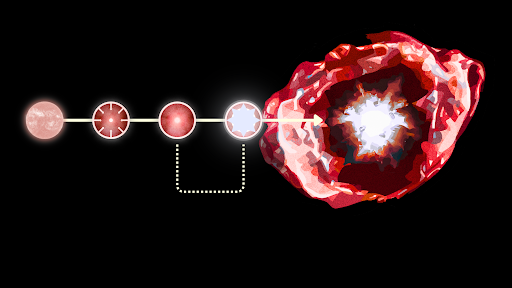
Figure 1. Timeline of supernova messengers from Earth’s perspective.
If a supernova occurs in the Milky Way, it would likely be one of the brightest objects in the night sky and could even be visible during the day. Galactic core-collapse supernovae have been observed by the naked eye and through their remnants using optical telescopes. Although the most recent supernova that humans saw with the naked eye was Kepler’s Supernova in 1604, that was not a core-collapse nor the most recent one at all. It was simply the last visible supernova. In the late 1600s, a core-collapse supernova occurred in the constellation Cassiopeia within the Milky Way, but no one knew about it for hundreds of years until its remnant was later discovered.1
Gravitational Waves
A star will send out invisible messengers before we see the supernova. As its core collapses, the star releases gravitational waves—ripples in spacetime—that bend the fabric of the Universe as they pass through space carrying information about how matter behaves deep within the core, where the physics remain a mystery.2
We can detect these invisible ripples in spacetime on Earth using LVK: the Laser Interferometer Gravitational-Wave Observatory (LIGO) in the US, Virgo in Italy, and the Kamioka Gravitational Wave Detector (KAGRA) in Japan. LIGO and Virgo have L-shaped detectors that act as rulers, sensitive enough to measure tiny stretches and squeezes in spacetime as small as one ten-thousandth of the width of a proton. That’s like detecting a change in distance to our nearest star (roughly 4.2 light-years away) the width of a human hair. LVK is sensitive to gravitational waves in the same frequency range as what humans can hear. The first observation of gravitational waves from a pair of merging black holes known as GW150914 was revolutionary, allowing us to “hear” the Universe for the very first time.
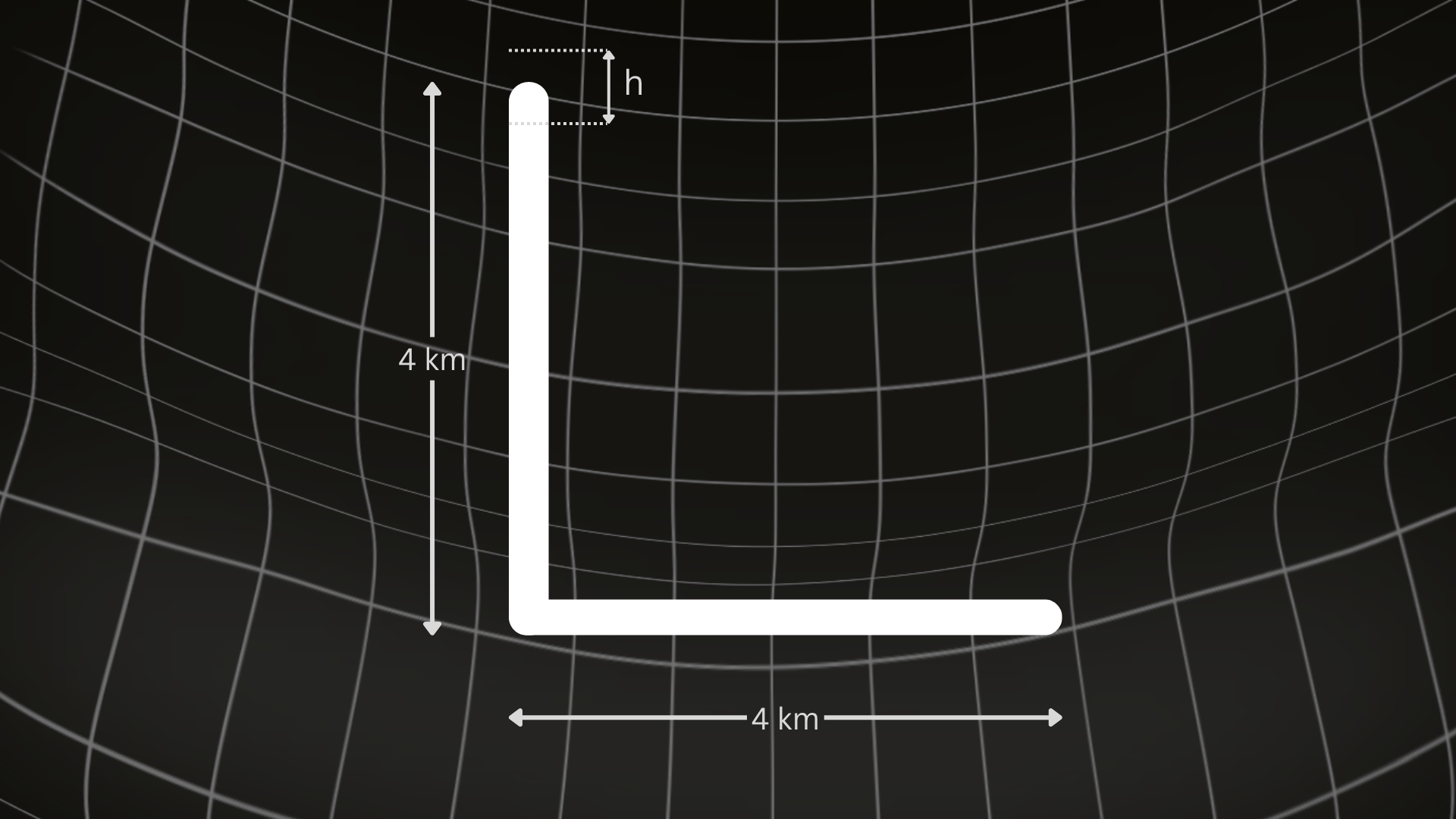
Figure 2. Illustration of one LIGO detector and its arms.
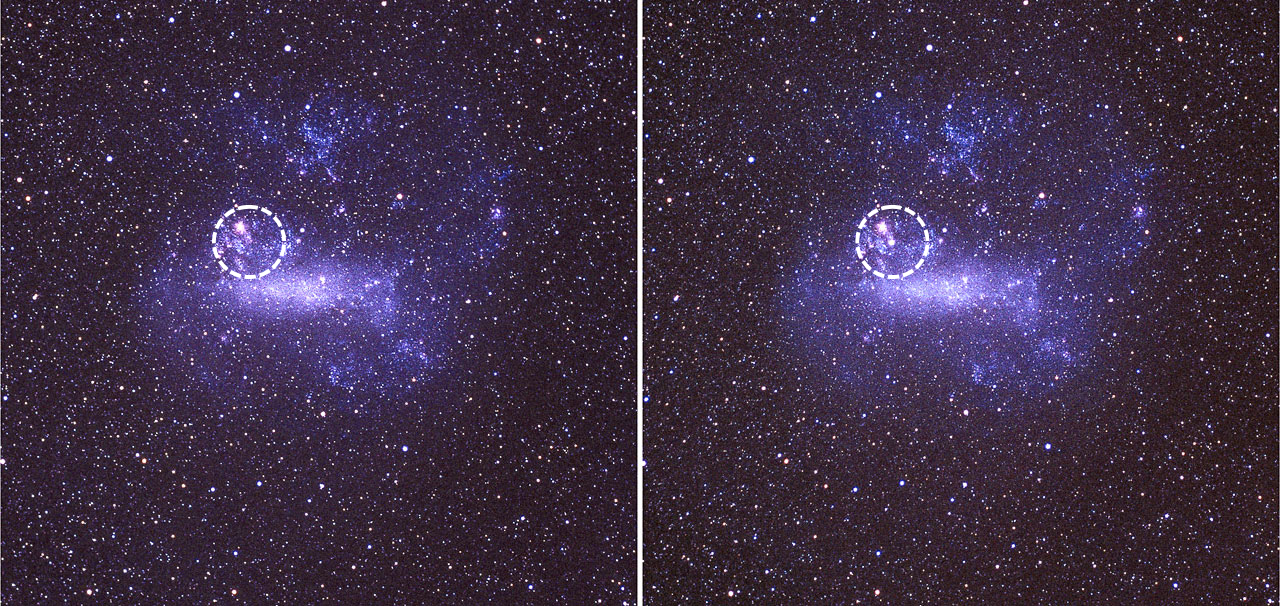
Figure 3. Before and after: SN1987A, a supernova event occurring in February 1987, visible to the naked eye in the Large Magellanic Cloud, a neighbouring dwarf galaxy outside our Galaxy. Adapted from [3].
Flow matching, a framework for training machine learning models, is a state-of-the-art method for rapid sky localisation using Bayesian inference. The model uses neural networks to learn a velocity field between a normal distribution and the posterior distribution of the sky parameters given the gravitational wave detector signals [4]. You can think of this as shaping a cloud: initially, the cloud is spread out randomly in a normal distribution, and the model learns how to push and shape this cloud into the posterior distribution, based on the signals at each detector.
Once trained, the model takes detector signals as input and produces the posterior distribution of sky locations as the output, indicating the most likely regions of the sky to hunt. Running sky localisation using flow matching could take mere milliseconds.
Stars that become core-collapse supernovae live relatively short lives; they’re born close to where they die and are mainly found in the disk and spiral arms of the Milky Way. These high-mass O- and B-type main-sequence stars are typically formed in large gravitationally unbound groups. We simulated two million supernova locations within the Milky Way using the package SNOB [5].
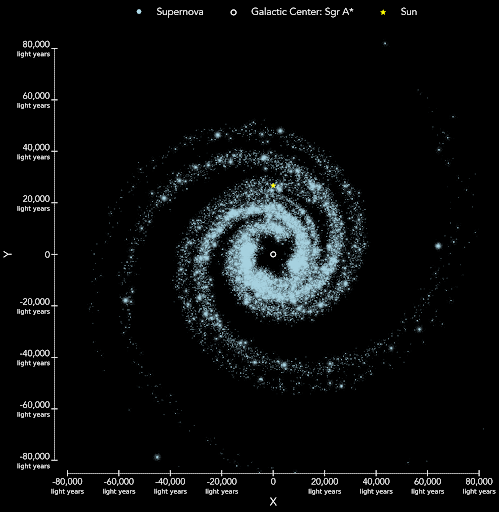
Figure 4. Galactocentric X-Y distribution of simulated supernova locations in the Milky Way, concentrated around the thin disk and spiral arms. The Sun's location is shown relative to the Galactic center, a supermassive black hole.
Gravitational wave signals, taken from Richers’ catalogue, contain roughly 1,700 unique simulated signals [6]. To generate training data, we pair samples of simulated core-collapse supernova sky locations and signals, then transform the signals based on the source location and phase to produce three signals, one for each detector: LIGO (Hanford and Livingston) and Virgo. We then add detector noise. Figure 5 illustrates an example of one core-collapse supernova gravitational wave signal between three detectors, where the supernova is located 25,000 light-years away towards the Galactic bulge.
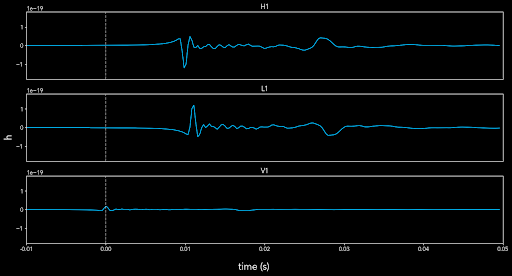
Figure 5: Core-collapse supernova gravitational wave detector signal example. Strain on the y-axis over time in seconds.
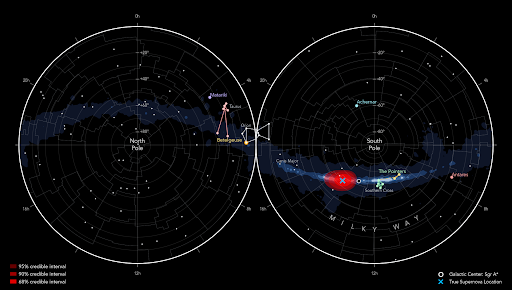
Figure 6. Celestial map of the sky at an arbitrary time, showing the Milky Way as a blue band and posterior distribution for sky location in red.
The simulated supernova locations are projected onto our sky in the celestial map. These points will take the form of a long band, which you’ll probably recognise as the Milky Way in the night sky. The position of the Galaxy changes throughout the day and year from our perspective on Earth as we rotate and orbit around the Sun. The celestial map is only one snapshot in time.
The model is trained on detector signals and corresponding true sky locations. Preliminary results indicate a reasonably narrow and accurate posterior distribution for sky location. Training takes several hours, and inference takes less than one second using a consumer laptop. Although the results look good, this research is still a work in progress. We still need to quantify the differences in computation time, accuracy, and precision of my approach versus existing approaches.
The future, meaning, and impact on science
Supernovae have appeared in stories and sparse historical records for millennia, like guests in the night sky, yet many aspects of them remain a mystery. Observing their gravitational wave signals would allow us to uncover how matter behaves under extreme conditions and hunt them down quickly to study their explosion in detail.
Although our lives are brief compared to stellar timescales, I hope that within this century we will observe gravitational waves from a core-collapse supernova. With next-generation detectors such as the Einstein Telescope, our “ears” will become far more sensitive, allowing us to cast our net further out to the Andromeda galaxy and beyond. Now, we must wait…
[1] S. M. Adams, C. S. Kochanek, J. F. Beacom, M. R. Vagins, and K. Z. Stanek, “Observing the Next Galactic Supernova,” Astrophys. J., vol. 778, no. 2, p. 164, Nov. 2013, doi: 10.1088/0004-637x/778/2/164.
[2] J. Fuller, “Pre-supernova outbursts via wave heating in massive stars – I. Red supergiants,” Mon. Not. R. Astron. Soc., vol. 470, no. 2, pp. 1642–1656, May 2017, doi: 10.1093/mnras/stx1314.
[3] European Southern Observatory. “The Large Magellanic Cloud before and after SN1987A.” eso.org. [Online]. Available: www.eso.org/public/images/eso0708b/.
[4] Y. Lipman, R. T. Q. Chen, H. Ben-Hamu, M. Nickel, and M. Le, “Flow Matching for Generative Modeling,” arXiv, doi: 10.48550/arXiv.2210.02747.
[5] M. Kachelrieß and V. Mikalsen, “Galactic distribution of supernovae and OB associations,” Comput. Phys. Commun., vol. 311, p. 109537, June 2025, doi: 10.1016/j.cpc.2025.109537.
[6] S. Richers, C. D. Ott, E. Abdikamalov, E. O’Connor, and C. Sullivan, “Equation of state effects on gravitational waves from rotating core collapse,” Phys. Rev. D, vol. 95, no. 6, Mar. 2017, doi: 10.1103/physrevd.95.063019.

Tarin is currently studying a Masters of Science in statistics and is passionate about astronomy, ecology, and science communication.