
Holographic Imaging with Incoherent Light
Biophotonics and imaging | Ayver-Lee Teinakore
Everyone has taken a blurry photo before. As we know, no amount of filtering or editing afterwards can bring back true details lost in the blur. With holography, this all changes. You can take an image and digitally reconstruct the object at different distances, including when it would be in focus. This is the attraction of holography—the ability to digitally refocus an image after it has already been taken—and this was generally believed to only be achievable with expensive lasers until the late 20th century [1].
In the world of conventional photography, features that are out of focus are lost forever. But that is not the case for holographic imaging. Holography is a technique that captures the full 3D information of a sample or object via interference patterns. While holographic imaging is not necessarily new, the type of light source used and the method through which it is implemented as presented in this article is novel. This work demonstrates holographic imaging without the powerful, expensive lasers that holography usually demands, using the familiar, yet unpredictable, light of an ordinary LED instead.
To understand the novelty of what was built, it helps to first understand what a normal photograph is missing. When light hits the sensor in your phone or camera, it records the brightness (intensity) at each point. This creates a limited, fundamentally flat 2D image, and all depth information about the sample is lost.
Holography works differently. It is a technique that records wavefronts and is able to reconstruct them at a later time [2]. A hologram is a recording of an interference pattern that can reproduce a 3D light field using diffraction. The hologram encodes both lateral and axial information about the object of interest [3]. With digital data processing, we can extract and make use of additional information about the object from the hologram.
Usually, this interference is created when light waves with sample-obstruction or changes in phase are mixed with a known, stable ‘reference' wave. This is traditional holography, done with coherent light sources. A coherent light source (like a laser) has a stable phase, this means that when the light is split into two paths, each path has an identical phase, and one can therefore subtract a reference beam from the object beam to isolate the object information.
But as the title of this article suggests, we are not using coherent light sources. We use incoherent light, such as sunlight, ordinary lamps, or regular LEDs. They are far cheaper, more accessible and more versatile than coherent sources, and do not require highly specialised active illumination of the object. However they have unpredictable phase relationships, so the usual method of subtracting a reference beam from an object beam no longer applies. So what `interferes' at the detector, if not a reference and object beam?
Figure 1 shows the concept of using an interferometer to generate two images of a sample, with their fields interfering at the detector plane. Both images, generated by the two arms of the interferometer, are focused at different points: one in front of the detector and one behind. Their interference pattern is captured by the detector, which contains phase and intensity information in the form of a complex-valued hologram (CVH), and from this CVH we are able to reconstruct the sample at different distances [3]. Each reconstruction of the sample at a different axial depth can be considered its own ‘slice' in a 3D stack of slices, which we can step through to determine the best focusing distance.
The key to understanding why this works lies in the physics of a concept called the point spread function (PSF) [2]. In any imaging system, a perfect point of light—like a tiny, sub-resolution pinhole—never appears as a perfect point in the image. Instead, it is blurred into a specific pattern, determined by the optics. This pattern is the PSF. The PSF tells you everything about the system's resolution. In our setup, however, we are not just interested in the PSF, but in the interference between two different versions of it. Because the two interferometer arms create images focused at different planes, the detector captures the interference between two distinct PSFs: one from an image focused in front of the sensor, and one from an image focused behind it. The resulting pattern uniquely encodes the 3D position of the source like a distinctive ‘fingerprint’, which we call a point spread hologram (PSH). Crucially, this PSH changes in a predictable way depending on where the original point source was located along the depth (or axial) axis. This is how the depth information is encoded—not in a single sharp image, but in the shape and structure of the interference pattern itself.
Figure 1 shows the concept of using an interferometer to generate two images of a sample, with their fields interfering at the detector plane. Both images, generated by the two arms of the interferometer, are focused at different points: one in front of the detector and one behind. Their interference pattern is captured by the detector, which contains phase and intensity information in the form of a complex-valued hologram (CVH), and from this CVH we are able to reconstruct the sample at different distances [3]. Each reconstruction of the sample at a different axial depth can be considered its own ‘slice' in a 3D stack of slices, which we can step through to determine the best focusing distance.
The key to understanding why this works lies in the physics of a concept called the point spread function (PSF) [2]. In any imaging system, a perfect point of light—like a tiny, sub-resolution pinhole—never appears as a perfect point in the image. Instead, it is blurred into a specific pattern, determined by the optics. This pattern is the PSF. The PSF tells you everything about the system's resolution. In our setup, however, we are not just interested in the PSF, but in the interference between two different versions of it. Because the two interferometer arms create images focused at different planes, the detector captures the interference between two distinct PSFs: one from an image focused in front of the sensor, and one from an image focused behind it. The resulting pattern uniquely encodes the 3D position of the source like a distinctive ‘fingerprint’, which we call a point spread hologram (PSH). Crucially, this PSH changes in a predictable way depending on where the original point source was located along the depth (or axial) axis. This is how the depth information is encoded—not in a single sharp image, but in the shape and structure of the interference pattern itself.
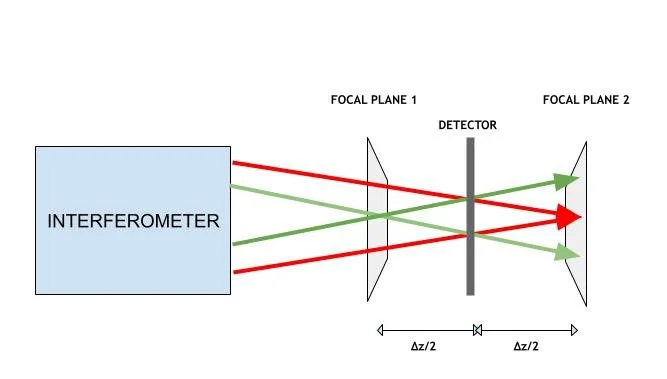
Figure 1. Schematic showing the principle behind our interferometer. Each arm (hidden within the `interferometer' box) generates a separate field associated with an image of the sample (shown as red or green arrows respectively), and results in two fields interfering at the detector.
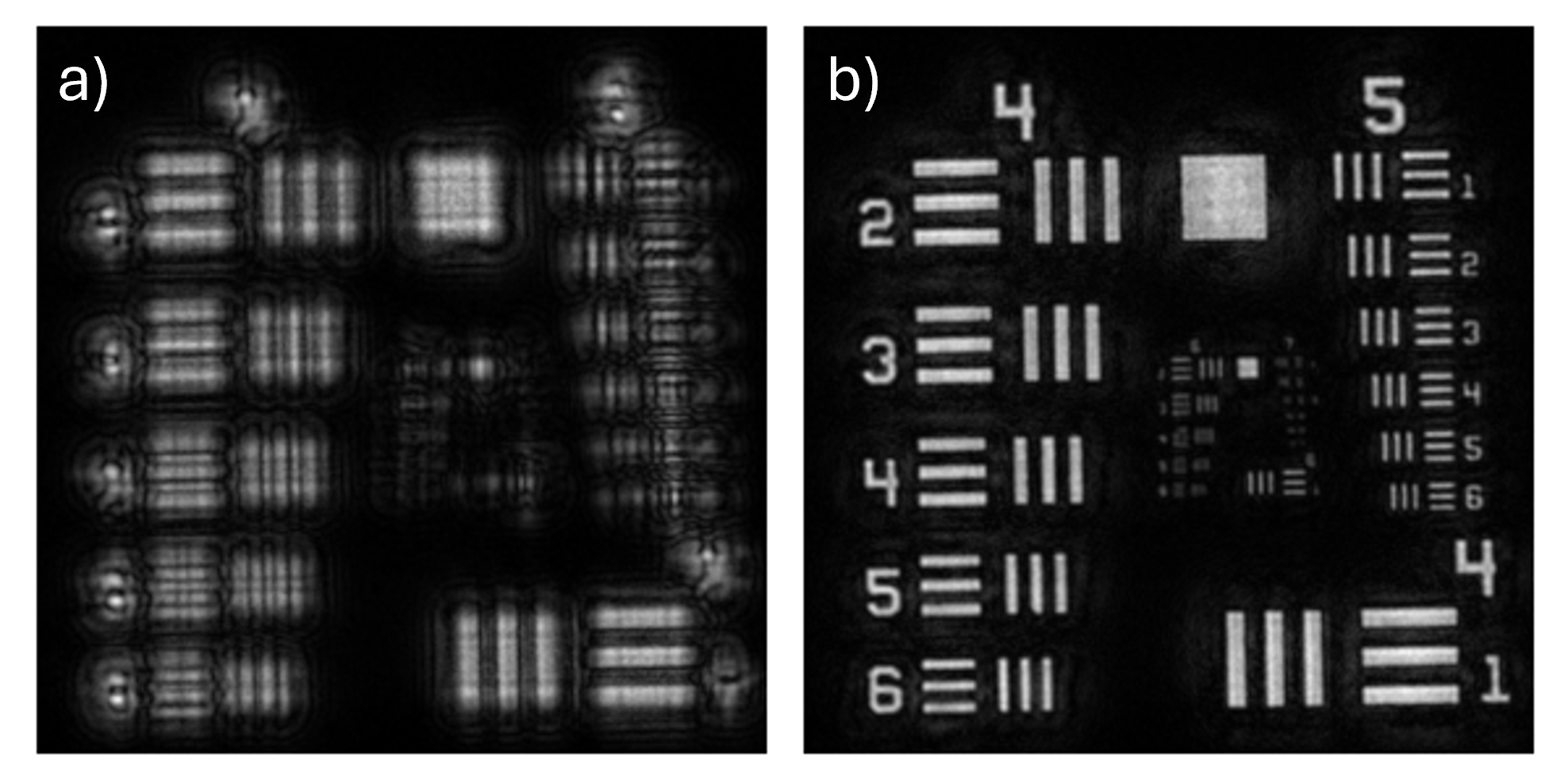
Figure 2a. The out-of-focus image captured by the detector, with a reconstruction distance of 0 mm. Figure 2b. After digital propagation to the optimal reconstruction depth, details that were not discernible in the out-of-focus image are recovered. Photo provided with permission from Tillmann Spellauge, Department of Physics, University of Auckland, 2025.
[1] M. M. Laurent, G. Y. Sirat, and D. Charlot, “Conoscopic holography: two-dimensional numerical reconstructions,” Opt. Lett., vol. 18, no. 1, pp. 66-68, Jan. 1993, doi: 10.1364/OL.18.000066.
[2] J. W. Goodman, Introduction to Fourier Optics, 2nd ed., New York, NY, USA: McGraw-Hill, 2005.
[3] T. Spellauge, “Telecentric Correlation Holography: A Novel Method to Record Fresnel Incoherent Correlation Holograms,” M. S. thesis, Department of Applied Sciences and Mechatronics, Munich University of Applied Sciences, Munich, Germany, 2023.
Ayver-Lee Teinakore is currently an MSc student at the University of Auckland studying experimental quantum optics. When she’s not fixing a broken laser, tapering a fiber, or TA-ing undergraduates, she enjoys reading, drawing, and playing piano.