
De-Extinction in Aotearoa: How Do Scientific Ethics and Mātauranga Māori Impact Resurrection Biology in New Zealand?
De-extinction and Mātauranga Māori| Anya Worthington
Extinction: the permanent loss of a species. In Aotearoa, approximately half of the country’s vertebrate fauna and a great deal of invertebrates have gone extinct over the 750 years that humans have lived here [1]. Species such as the Haast’s eagle, huia, and moa are lost indefinitely…or, maybe they aren’t.
As science rapidly evolves, solutions to combating extinction arise, including its potential reversal. De-extinction reimagines evolutionary science in the modern world. Using methods including cloning, back-breeding, and genome editing [2], scientists are capable of developing new versions of species that were previously lost to extinction.
Such revolutionary progress presents immense advancements in genetic technology, prospective revitalisation of ecosystems, and contributions to conservation efforts. However, this development has created ethical controversy. Many argue that resources would be better directed towards critical work with endangered species [3], or that de-extinction could introduce ecological disruptions and animal welfare issues.
Being so contentious, the topic of de-extinction in Aotearoa instigates a great deal of discussion around its necessity and morality. This introduces the crucial consideration of scientific ethics and Mātauranga Māori in decisions surrounding the acceptance and incorporation of de-extinction in New Zealand’s scientific environment.
How does de-extinction work?
De-extinction is made possible through cloning, back-breeding, and gene-editing [2]. Back-breeding is a more limited approach, selecting desired traits from a closely-related living species to recreate an extinct population. This forms a similar species to the extinct one but is only an altered version of a living species.
Cloning requires the species to still exist, using embryo division to increase the population of a species close to extinction. This is an efficient technique but is unable to bring back an extinct species.
Genome-editing is the most accurate technique for resurrecting an extinct species, creating a hybrid between living and extinct organisms. Recovered DNA from the extinct species is edited and inserted into a similar living species, creating a blend that is most like the extinct species.
Has de-extinction been successful before?
The genome editing technique has been proven successful by Colossal Biosciences with the dire wolf in late 2024 [4]. Using a 13,000 year old tooth and a 72,000 year old skull, DNA was extracted, edited, and then combined with grey wolf DNA, leading to the birth of three dire wolf pups via surrogate domestic dogs. Exhibiting dire wolf traits and instincts, these hybrids are the first of their kind to exist since their extinction at the end of the ice age, approximately 13,000 years ago.
What are scientific ethics?
Scientific ethics encompass principles, namely honesty and integrity [5], that ensure individuals, communities, and surrounding aspects are protected and respected. They aren’t defined by a single entity, but by a combination of international bodies, professional organisations, and individual researchers.
The United Nations Educational, Scientific and Cultural Organisation (UNESCO) is a specialised agency of the United Nations that promotes international cooperation in science, education, culture, and communication. UNESCO’s core ethics frameworks for science are outlined in their foundational documents [6] that set out international norms defining scientific principles, with which universal ethical evaluations aim to align. These frameworks guide the discussion of how scientific ethics impact resurrection biology in New Zealand.
What is Mātauranga Māori?
Mātauranga Māori is a cultural system of knowledge and a vital component of science in Aotearoa. Built on te ao Māori, it is a crucial aspect of Māori culture and identity that provides tools for thinking and organising information. A dynamic concept that constantly adapts, it defines what is important and how knowledge should be used. On the topic of science in Aotearoa, Mātauranga is a necessary consideration and should remain a priority as major topics such as de-extinction arise.
Why is de-extinction relevant in Aotearoa?
De-extinction projects are large-scale, multi-million-dollar efforts that demand years of work. Current projects include only the biggest names in the world of extinct species: woolly mammoths, the dodo, Tasmanian tigers, and—as recently revealed—the moa. Moa were large, flightless, herbivorous birds endemic to Aotearoa. The nine moa species ranged in height and size, with the largest (South Island giant moa) standing up to 3.6 metres tall and weighing as much as 250 kilograms. Moa went extinct approximately 600 years ago primarily due to human hunting.
New Zealand filmmaker Sir Peter Jackson approached Colossal Biosciences, the team behind the dire wolf de-extinction project, and agreed to support their work in exchange for a project aimed at moa de-extinction [7]. This has brought ground-breaking research straight to Aotearoa, making it more relevant than ever [8]. Colossal Biosciences and Jackson are working alongside Te Waipounamu iwi Ngāi Tahu and the Canterbury Museum to bring this initiative to life, prioritising a Māori-led approach. Ngāi Tahu will become the owners of the moa [9] and plan to release them on their own land in a habitat matching their original domain.
How do scientific ethics impact de-extinction in Aotearoa?
A central ethical issue that is prevalent throughout the de-extinction conversation is the use of surrogate animals. They play a critical role in the process, but the nonconsensual instrumentalisation of these animals is at the forefront of discussion due to their welfare [10]. Surrogate animals could be expected to undergo invasive procedures and hormone treatments, alongside the risk of difficult or failed pregnancies and even death. In the dire wolf de-extinction project, no surrogate dogs were reported to have experienced any miscarriages or deaths; however this is only one project, and future surrogate species are likely to differ significantly from dogs, which could alter outcomes.
With de-extinction being such a new concept, the rules aren’t always clear. Precisely how many details about resurrection projects need to be made public is uncertain, but it is ethically important to ensure that particulars are shared to guarantee honesty and accountability. Being open about limitations and failures with the public allows for increased trust in science and relevant organisations. Colossal Biosciences provide general information about their past projects and future plans, but further transparency is required to prevent harm, establish accountability, and protect societal and cultural rights.
Lack of a sustainable ecosystem is another problem for revived species. The extinct species’ primary habitat could no longer exist or have been altered beyond recognition, and the new species would have to adapt to today’s Anthropocene environment. Alongside this struggle with reintroduction, a new threat may be introduced to species already residing in the area. Diverting resources from existing species and introducing a potential new predator could disrupt the current ecosystem and alter the immediate landscape. This has ethical implications on the revived species, the environment, and existing species. The dire wolf is yet to be released and therefore these impacts have not yet been measured, but they are significant components to be considered prior to any releases.
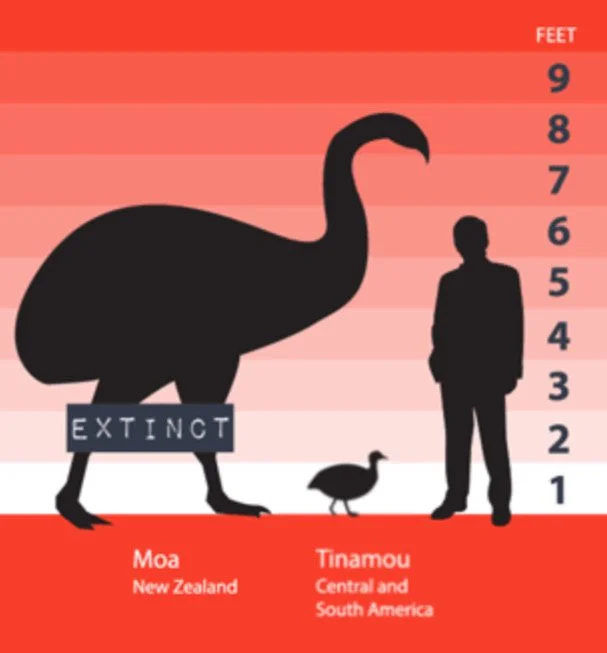
Figure 1. Size comparison of extinct and extant flightless birds. Silhouette illustration comparing the height of an extinct moa (New Zealand) with a modern human and a living tinamou (Central and South America), the closest living relative to the Moa. The figure highlights the exceptional size of moa relative to humans and surviving flightless birds.
As de-extinction is so expensive, many question whether these costs could be redirected towards technology that improves the lives of living organisms, such as protecting their habitats. In today’s world a great number of species are on the brink of extinction, often due to human actions. Putting this money towards supporting their lives and boosting meaningful projects could arguably be a better use—protecting what we still have as opposed to what we have lost. Opportunity costs highlight the ethical dilemma of where this money is best spent.
Scientific ethics influence de-extinction in Aotearoa by demanding examination of surrogate animal welfare, transparency, quality of habitat, and diversion of resources from vulnerable groups. Directing attention and demanding information means the wider public can keep relevant groups accountable and ensure changes are made where necessary. Scientific ethics force de-extinction projects to occur honestly and with respect to elements at risk.
How does Mātauranga Māori impact de-extinction in Aotearoa?
In the case of moa de-extinction, Ngāi Tahu have expressed their dedication to ensuring that the Māori-led project progresses with rangatiratanga and tikanga [11], aligning with Mātauranga values. These principles demonstrate the immediate change implemented into this project.
Prioritising rangatiratanga allows Māori to lead the project instead of acting as consultants, maintaining Mātauranga as a legitimate knowledge system in science and ensuring decisions are made based on relational ethics as well as technical aspects. Māori will have control over data and genetic material, supporting Māori data sovereignty and protecting autonomy. Emphasis on tikanga means Mātauranga sets the project’s ethical boundaries, centralising respect for tapu and mauri. Processes are considered as important as the outcomes, with Mātauranga informing decision-making and tikanga ensuring that knowledge is used respectfully.
As a result of the gene-editing technique that Collossal Biosciences will use to resurrect the moa, concerns arise around altering the whakapapa of an existing species. The moa hybrids may not be equipped to their new habitats, or they could be so well adapted that they become disruptive. A further implication of this is the possibility that the mauri of the new moa species will be altered or fundamentally changed to the point where there is uncertainty as to whether the hybrid is legitimately a moa at all. Mātauranga impacts de-extinction by determining whether the new species can be recognised as a taonga. But there is more to consider outside of the project team itself. Ngāi Tahu is only one iwi, and others across Aotearoa are yet to voice support for moa de-extinction.
Article 2 of Te Tiriti o Waitangi states that Māori have exclusive rights to taonga—in this case, the moa. Additionally, Waitangi Tribunal claim WAI 262 highlights the intellectual property rights that Māori have over Aotearoa’s flora and fauna. Acting in breach of these collective taonga rights could lead to various legal and cultural implications by failing to include the collective, potentially being seen as overstepping the rangatiratanga that Ngāi Tahu are working hard to prioritise. It is important that Māori across Aotearoa can share their opinions, and calls for a national consensus have been made prior to the project going ahead. This would allow decisions to meet the needs of wider Māori communities and better align with Mātauranga.
Ultimately, the inclusion of Mātauranga helps ensure that the project progresses ethically and with respect to Māori, the environment, and the moa species itself. The impact of Mātauranga is an important one and is necessary to guarantee things are done the right way, ethically and culturally. There is still more to be done to ensure Mātauranga principles can be more widely implemented, but the current impact of Mātauranga has been positive and effective thus far.
Conclusion
In Aotearoa, de-extinction sits at the intersection of revolutionary science, ethical responsibility, and Indigenous knowledge systems. Advances in technology prove the increasing possibility of successful resurrection biology, but the possibility alone is insufficient justification. Both scientific ethics and Mātauranga Māori have the power to impact and influence de-extinction in Aotearoa. However, they must be taken seriously and considered throughout the entirety of the project in order to do so. Scientific ethics demand the careful consideration of ecological risk, animal welfare, transparency, and opportunity costs, requiring openness and accountability to determine success and sustainability. Mātauranga Māori builds on the ethical framework by reshaping de-extinction from a mere biological issue to a relational and cultural one as well. For de-extinction to occur in Aotearoa it must first be grounded by robust scientific ethics and genuine Māori leadership rooted in Mātauranga. It is a challenge to New Zealand to look not only at what science can do, but what it should do—and whose knowledge defines that boundary.
[1] R. Holdaway. “New Zealand extinctions since human arrival.” Te Ara – The Encyclopedia of New Zealand. Accessed: Aug. 23, 2025. [Online]. Available: https://teara.govt.nz/en/extinctions/page-4.
[2] S. Ord. “How De-Extinction Works.” Colossal Biosciences. Accessed: Oct. 6, 2025. [Online]. Available: https://colossal.com/how-de-extinction-works/.
[3] P. Ehrlich and A. H. Ehrlich. “The Case Against De-Extinction: It’s a Fascinating but Dumb Idea.” Yale Environment 360. Accessed: Dec. 4, 2025. [Online]. Available: https://e360.yale.edu/features/the_case_against_de-extinction_its_a_fascinating_but_dumb_idea.
[4] J. Kluger. “The Return of the Dire Wolf.” Time. Accessed: Sept. 17, 2025. [Online]. Available: https://time.com/7274542/colossal-dire-wolf/.
[5] ScienceDirect. “Ethics of Science.” sciencedirect.com. Accessed: Oct. 6, 2025. [Online]. Available: https://www.sciencedirect.com/topics/social-sciences/ethics-of-science.
[6] UNESCO. “Ethics in Science.” unesco.org. Accessed: Nov. 22, 2025. [Online]. Available: https://www.unesco.org/en/query-list/e/ethics-science.
[7] K. Bayer. “South Island giant moa de-extinction plans: Sir Peter Jackson teams up with Colossal Biosciences.” The New Zealand Herald. Accessed: Dec. 4, 2025. [Online]. Available: https://www.nzherald.co.nz/nz/south-island-giant-moa-de-extinction-plans-sir-peter-jackson-teams-up-with-colossal-biosciences/5M5QPE2VWVBYRAXPWH6OWOO4DY/.
[8] Midday Report and Morning Report. “Sir Peter Jackson backs project to de-extinct moa, experts cast doubt.” RNZ. Accessed: Dec. 16, 2025. [Online]. Available: https://www.rnz.co.nz/news/national/566386/sir-peter-jackson-backs-project-to-de-extinct-moa-experts-cast-doubt.
[9] Colossal Biosciences. “The Moa.” colossal.com. Accessed: Jan. 2, 2026. [Online]. Available: https://colossal.com/moa/.
[10] [1] J. Odenbaugh, “Philosophy and ethics of de-extinction,” Cambridge Prisms: Extinction, vol. 1, p. e7, 2023. doi:10.1017/ext.2023.4.
[11] N. Rawlence and P. Wilcox. “Return of the huia? Why Māori worldviews must be part of the ‘de-extinction’ debate.” RNZ. Accessed: Jan. 2, 2026. [Online]. Available: https://www.rnz.co.nz/news/national/561131/return-of-the-huia-why-maori-worldviews-must-be-part-of-the-de-extinction-debate.
Figure 1. Reference:
PBS. “Big Birds in Perspective”. Nature I PBS. Accessed: Jan 2, 2026. [Online]. Available: https://www.pbs.org/wnet/nature/big-birds-cant-fly-ratite-size-comparison/12799/
Anya is a third-year student with a keen interest in sustainability, pūtaiao, and the intersection between law and science. Outside of study you can find her on the hockey turf or dodging jellyfish at the beach.