
Chemistry of Convenience: How Modern Life Designs Pollution
Chemical Design and Green Chemistry| Nargiss Taleb
Have a think about how you started your day. Maybe you made some eggs in a frying pan that nothing sticks to, or made instant oats from an easy-to-go paper sachet. It started raining, so you put on a jacket that makes water bead off its surface to keep you dry. Perhaps it was a little cold on the way to work, so you stopped for a coffee in a paper takeaway cup from your local café.
Now, there is nothing particularly exciting about this sequence of events. However, that is simply the point, chemistry has made many parts of your morning possible. Modern life has been built around convenience to such an extent that we rarely stop to think about why the products we use every day work so well. Why was your jacket able to keep you dry in the rain? Why, despite paper normally absorbing liquids, did your coffee stay inside its cup rather than soaking straight through?
Chemistry and chemical engineering allow us to change the properties of materials, creating products with specific characteristics that make our lives easier. Simple materials can be modified, combined or coated to become resistant to water and grease, withstand heat, prevent degradation or remain durable for long periods of time. These are impressive solutions to practical problems. Whilst we have become exceptionally good at designing materials to do exactly what we want them to do, such as resisting degradation during use, we haven't always considered what happens to those chemicals after use. The problem is not that we have learned how to make materials last, it’s that the chemical properties that make them last are not always ‘switched off’ when their useful life ends. This is where the convenience of chemistry can start creating pollution.
Case Study: PFAS
Chemicals that are designed to be durable don’t suddenly break down in the environment, they persist and accumulate. Some chemicals readily break down through natural processes such as radiation exposure, microbial activity or chemical reactions. Others are much more resistant to these processes. Their chemical structures allow them to persist in the environment long after the product they were used in has disappeared.
Per and polyfluoroalkyl substances, better known as PFAS, are a great example of how something previously brought around as a tool for us has become a widespread issue. PFAS are a large group of compounds that contain a strong carbon-fluorine bond that provides strong water/oil resistance and chemical stability [1]. These incredibly useful qualities allowed them to be used since the 1940s for various industrial, commercial and consumer applications [2]. One familiar application is the non-stick coating on cookware, specifically Teflon pans by DuPont [3] . Suddenly, food that once stuck stubbornly to a pan could slide away with barely any effort due to the magic properties of PFAS. The applications only grew from there, as we started using it in clothes for waterproofing, takeaway containers for durability and much more (Figure 1). PFAS obviously does not know where it is being used. Its chemical properties do not disappear when a product is discarded and thus can pose major risks impacting ecosystems [4]. Whether it is on a jacket, in a river, in a popcorn bag or in soil, the underlying chemistry is still there. This is where the problem with designing for convenience becomes clear. The same properties that make PFAS useful during the life of a product can make it difficult to remove once that product is no longer useful.
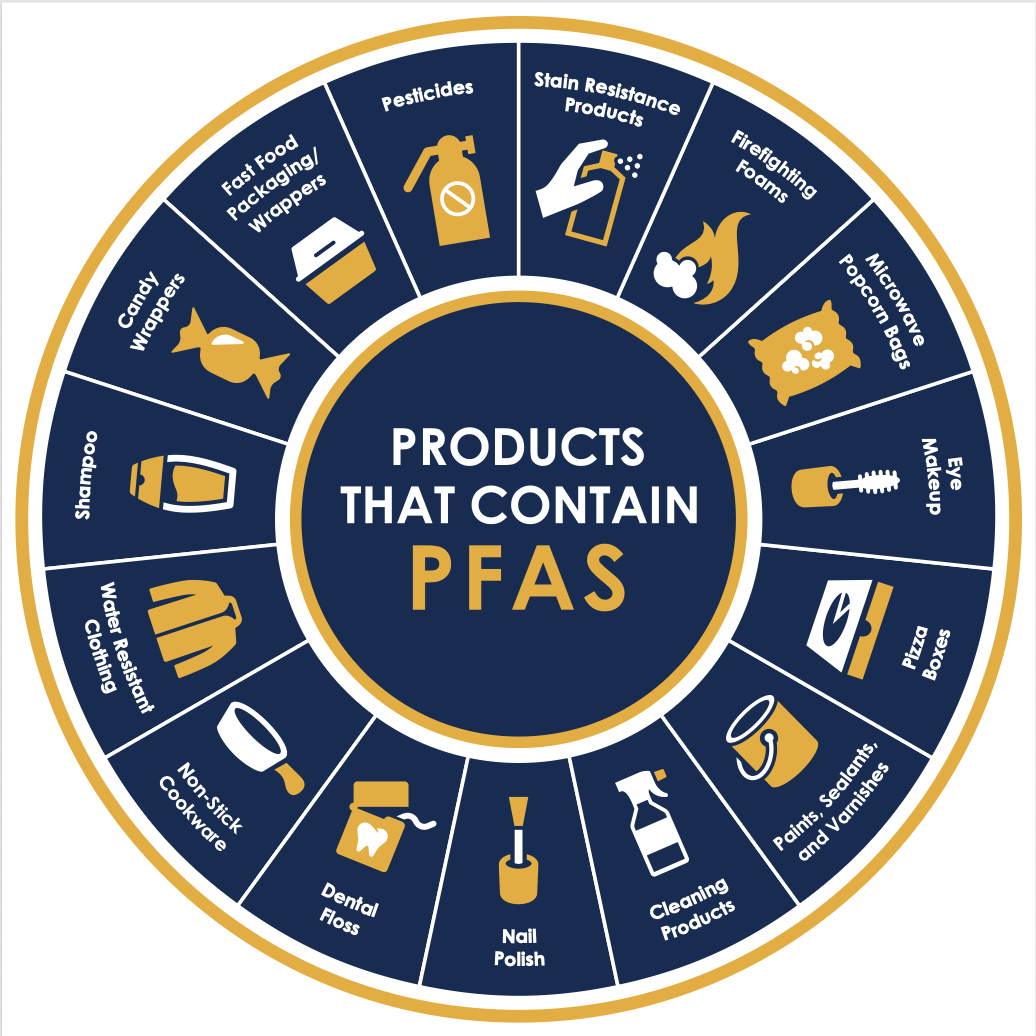
Figure 1. PFAS and its uses in various products [5]
This becomes even more complicated when we try to design products with a better end-of-life process. Compostable and biodegradable food packaging is designed to break down after use, at face value making it seem like an ideal solution to the problem of waste. However, what happens to the chemicals within the material? We know PFAS can be present in food packaging, both intentionally and unintentionally through contamination [6]. If the packaging fibers eventually break down, the disappearance of the material does not necessarily mean the disappearance of the chemicals associated with it. The PFAS does not become biodegradable simply because the packaging is. A product can therefore be designed to disappear while the chemistry responsible for its functionality remains. If the chemistry can outlive the product, maybe we need to think about its end-of-life right at the beginning: at the chemical design stage.
Designing for the afterlife
So, what should we value when we design chemicals? Typical successful chemical design assesses product effectiveness through functionality and durability during use. Green chemistry principles are incredibly valuable here, encouraging design of chemicals with their entire life cycle in mind [7]. For example, replacing PFAS with another persistent chemical that provides the functionalities would not address the underlying problem. The goal should be to design a chemical that not only performs during its use, but has a pathway for breakdown for when it is no longer useful.
Alternatives to PFAS already exist for some applications [8]. For example, paper compostable packaging can be treated with non-fluorinated coatings such as clays and waxes that provide water and grease resistance, showing that PFAS are not always necessary to achieve these functions [9]. However, the suitability of an alternative depends on the application, as PFAS-free materials may not always provide the same combination of performance, durability and cost. Simply replacing PFAS therefore does not automatically solve the problem. A successful alternative should provide the required function while also considering its persistence, toxicity and environmental fate. This shifts the focus from simply replacing one chemical with another to designing materials with their afterlife in mind.
This does not mean abandoning chemistry that makes modern life convenient. Chemistry has given us safer food, medicines, clean water, durable materials and technologies that have transformed how we live. The challenge is to make convenience compatible with the environment that remains after the convenience is gone.
PFAS shows us what happens when we become exceptionally good at designing chemicals to resist natural processes. The same carbon–fluorine chemistry that makes a product water-resistant, grease-resistant or durable can allow that chemistry to persist far beyond the product itself. So perhaps, when working towards innovation in chemistry, we should not simply ask how well we can make something work, but how we can responsibly ‘switch off’ its effects.
Modern pollution does not always begin when we throw something away, sometimes it begins when we design it. That is the chemistry of convenience - we design products for the life we want to use them for, but the environment inherits whatever chemistry we leave behind.
[1] L. G. T. Gaines, ‘Historical and current usage of per- and polyfluoroalkyl substances (PFAS): A literature review’, Am. J. Ind. Med., vol. 66, no. 5, pp. 353–378, 2023, doi: 10.1002/ajim.23362.
[2] I. T. Cousins, C. A. Ng, Z. Wang, and M. Scheringer, ‘Why is high persistence alone a major cause of concern?’, Environ. Sci. Process. Impacts, vol. 21, no. 5, pp. 781–792, May 2019, doi: 10.1039/c8em00515j.
[3] ‘The Long, Strange History of Teflon, the Indestructible Product Nothing Seems to Stick to’. Accessed: Sep. 01, 2026. [Online]. Available: https://www.smithsonianmag.com/science-nature/the-long-strange-history-of-teflon-the-indestructible-product-nothing-seems-to-stick-to-180984920/
[4] M.-E. Dimitrakopoulou et al., ‘Comprehensive analysis of PFAS presence from environment to plate’, npj Sci Food, vol. 8, no. 1, p. 80, Oct. 2024, doi: 10.1038/s41538-024-00319-1.
[5] ‘Understanding PFAS | riversideca.gov’. Accessed: Sep. 01, 2026. [Online]. Available: https://riversideca.gov/press/understanding-pfas
[6] L. P. Padhye, M. Kah, G. Baron, and N. Taleb, ‘Compostable Products in Aotearoa New Zealand’. The Ministry for the Environment, Nov. 2023. [Online]. Available: https://environment.govt.nz/assets/publications/Waste/compostable-products-in-aotearoa-nz.pdf?v=f8e5770d8646bc862276f43273a06dcbf506602c
[7] ‘12 Principles of Green Chemistry’, American Chemical Society. Accessed: Sep. 01, 2026. [Online]. Available: https://www.acs.org/green-chemistry-sustainability/principles/12-principles-of-green-chemistry.html
[8] R. Figuière, L. T. Miaz, E. Savvidou, and I. T. Cousins, ‘An Overview of Potential Alternatives for the Multiple Uses of Per- and Polyfluoroalkyl Substances’, Environ. Sci. Technol., vol. 59, no. 4, pp. 2031–2042, Jan. 2025, doi: 10.1021/acs.est.4c09088.
[9] Washington State Department of Ecology, ‘Per- and Polyfluoroalkyl Substances in Food Packaging Alternatives Assessment’. Feb. 2021. Accessed: Sep. 01, 2026. [Online]. Available: https://apps.ecology.wa.gov/publications/summarypages/2104004.html

Nargiss Taleb - BSc (Hons) majoring in Green Chemical Science
Nargiss is a graduate environmental chemistry researcher interested in contaminants and sustainability. She is passionate about science communication, sharing knowledge in accessible ways, and creating positive connections through effective communication and engagement.