
The Future of Thinking: Brain Health and AI Dependence
Artificial Intelligence, cognition, brain health, | Jack Styles
Artificial intelligence (AI) refers to computer systems designed to perform tasks that would otherwise require human intelligence, such as language understanding, pattern recognition, and idea generation. Rapid advances in large language models (LLMs) have brought AI into everyday life, transforming education, business, healthcare, and creative industries. Tasks that once demanded sustained cognitive effort can now be completed in seconds.
AI is not inherently harmful; rather, its effects depend on how it is used. Responsible engagement may enhance cognitive performance, but overreliance may undermine memory, attention, and long‑term neural health. The practical question, is not whether AI reshapes cognition, but how to cultivate a relationship with AI that strengthens, rather than replaces, human thinking.
The MIT Study
A recent study from the Massachusetts Institute of Technology (MIT) provides an early window into how the brain responds when AI performs cognitive work on our behalf [1]. Over four months, 54 students wrote essays either unaided, with search engines, or with the popular AI LLM ChatGPT, while researchers recorded the electrical neural activity via electroencephalography (EEG). The results were striking: compared with unaided writing, ChatGPT‑assisted writing was associated with a 47% reduction in overall brain connectivity, particularly in regions linked to memory and executive control; in post‑writing assessments, 83% of AI‑assisted writers could not accurately recall or quote the core ideas from their own essays [1].
A recent study from the Massachusetts Institute of Technology (MIT) provides an early window into how the brain responds when AI performs cognitive work on our behalf [1]. Over four months, 54 students wrote essays either unaided, with search engines, or with the popular AI LLM ChatGPT, while researchers recorded the electrical neural activity via electroencephalography (EEG). The results were striking: compared with unaided writing, ChatGPT‑assisted writing was associated with a 47% reduction in overall brain connectivity, particularly in regions linked to memory and executive control; in post‑writing assessments, 83% of AI‑assisted writers could not accurately recall or quote the core ideas from their own essays [1].
These differences were visually apparent in the EEG patterns: unaided writing produced dense, distributed activity in memory and planning networks; search‑assisted writing showed moderate engagement; and AI‑assisted writing showed noticeably reduced connectivity [1]. Although this study is small and non‑peer‑reviewed at the time of writing, it raises essential questions about the long‑term consequences of outsourcing mental effort.
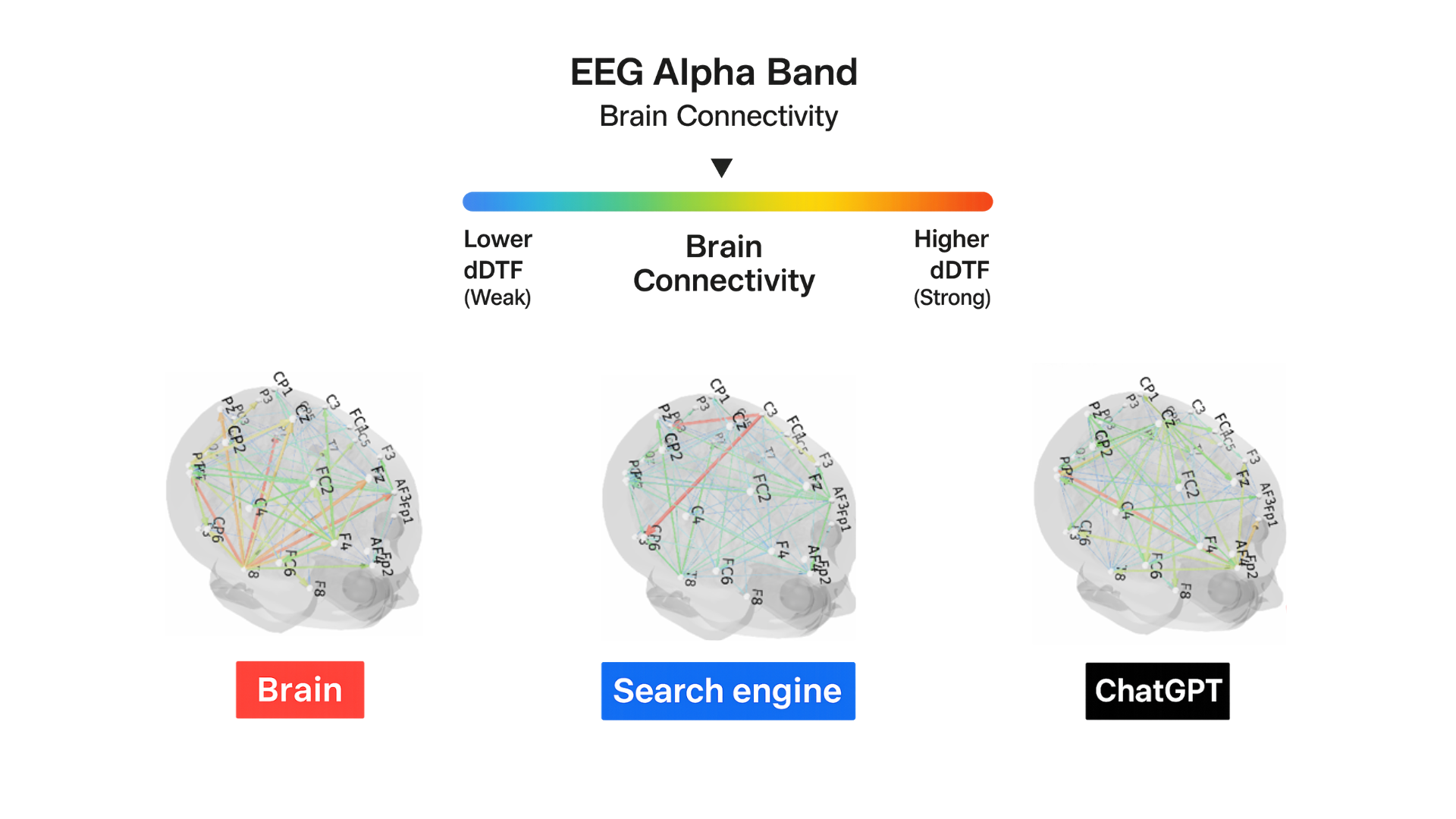
Fig. 1. EEG alpha-band brain connectivity during unaided writing, search-assisted writing, and ChatGPT-assisted writing. Adapted from [1].
Glossary
Electroencephalography: A non-invasive method that records the brain’s electrical activity using electrodes placed on the scalp.
Alpha band: A range of brainwave activity (approximately 8–12 Hz) commonly associated with relaxed wakefulness, attention, and internal cognitive processing.
Long‑Term Risks
The brain is often compared to a muscle: repeated cognitive effort strengthens neural pathways, whereas effortless performance erodes them over time. Evidence from ageing research suggests that mentally demanding work and lifelong learning are associated with better late‑life cognitive function, consistent with a “brain reserve” perspective, the idea that regular cognitive challenge builds a protective neural buffer that helps the brain remain resilient against ageing and neurological decline [2], [3]. In comparison, learners’ heavy dependence on AI has been linked to cognitive fatigue and lower critical thinking, effects partly mediated by mental exhaustion but buffered by literacy on the subject at hand [4].
Long‑term cognitive health is influenced by multiple factors, with risk markers ranging from physiological stress load to genetic predisposition [5], [6]. The concern is that chronic outsourcing of thinking may reduce engagement in processes that build brain reserve, potentially compounding existing vulnerabilities and/or illnesses. In other words, frictionless cognition today may come at the cost of diminished resilience tomorrow [2], [3], [1].
AI Cognitive Debt
The emerging concept of AI Cognitive Debt captures the hidden cost of repeatedly offloading thinking to an assistant [1]. Like financial debt, cognitive debt accumulates silently: users gain immediate efficiency but gradually weaken the neural systems responsible for deep reasoning, memory consolidation, and decision making. Crucially, this does not imply AI is harmful by nature. Harm arises when AI is used in the wrong way – substituted for thinking rather than supporting it. Used well, as a partner that challenges and clarifies, AI can amplify cognition. But used poorly, as a shortcut that replaces effort, it can narrow cognitive capacity over time.
Psychological & Children's Dimensions
Beyond cognition, patterns of AI use have significant emotional, psychological, and developmental consequences. Heavy reliance on AI can foster avoidance of “productive struggle” and reduce tolerance for difficulty, conditions that are essential for learning, especially in childhood and adolescence [7], [4]. When individuals repeatedly escape effortful thinking by delegating tasks to AI, they may gradually weaken the cognitive and emotional systems that support persistence, self‑regulation, and resilience. Over‑dependence can also limit regular monitoring and engagement with the outputted content, further lowering interaction with the material and reducing opportunities for critical thinking [4], [1]. In practice, this means AI use must be structured so it prompts critique, questioning, and refinement, rather than encouraging a passive, consumption‑based mindset.
These concerns are amplified in the context of children and young learners. AI is increasingly present in classrooms and homes, with recent reports showing early exposure to AI‑enabled tools and rising parental concern about excessive reliance [8], [9]. Early brain development depends on challenge, effort, and adaptation, the very processes that strengthen problem‑solving, memory, attention, and resilience [3]. When AI handles the “heavy lifting,” generating instant answers or ready‑made explanations, it risks displacing opportunities for struggle. Over time, young learners may begin to prioritise speed over comprehension, weakening independent thought and reducing their ability to tolerate uncertainty and work through the inevitable complexity of their lives [7], [3], [10].
Lessons from History: Calculators & Technology
Concerns about cognitive decline due to new technologies are not new. When calculators became widespread, educators worried that basic mathematical skills would dwindle [11]. Over time, calculators were integrated into learning by shifting attention from rote computation to conceptual reasoning. AI may offer similar benefits – provided it is used deliberately. If treated as a collaborator that extends thinking, AI can elevate creativity and deepen analysis; if treated as a substitute, it risks accumulating cognitive debt [1].
Human nature complicates this picture. People systematically prioritise short‑term rewards over long‑term outcomes [12]. Social media illustrates how reward‑learning designs can capture attention and shape behaviour [13]; short‑form video use has also been linked to degraded memory performance among youth [14]. Public‑health patterns such as obesity demonstrate how immediate gratification can outweigh known risks at population scale [15]. AI could follow the same trajectory unless habits and guardrails are intentionally designed.
The Path Forward: Using AI Wisely
A guiding principle moving forward is simple in theory: amplify, don’t replace. Practically, this means preserving cognitive engagement while using AI to extend capabilities. Evidence‑informed practices include:
Attempt a task first, then use AI to critique, clarify, and extend your ideas
For skills you aim to master (writing, reasoning, problem‑solving), favour AI for feedback over composition
Balance AI convenience with activities that build memory and cognitive control. Reading, flash cards and analogue note taking to name a few [7], [2], [3], [1].
Despite the rapid adoption of AI, long‑term cohort studies are needed to assess the biological and developmental impacts of sustained AI use, particularly in young learners [1]. AI brings immense opportunities to our lives, but also brings many questions regarding how it would affect today’s generation long term.
Conclusion: The Future of Thinking
AI is not intrinsically harmful to cognition. Its impact hangs on deliberate use. When AI is used to challenge, clarify, and extend thinking, it can enhance creativity and deepen learning. When it replaces effort, it risks weakening memory, diminishing problem‑solving capacity, and reducing brain reserve. The key task is therefore not to resist AI, but to design habits and environments in which AI amplifies human cognition rather than replacing it. Whether or not early findings like those from MIT ultimately hold up, they have sparked an essential conversation about the future of thinking and the biological consequences of convenience [1].
[1] N. Kosmyna et al., “Your Brain on ChatGPT: Accumulation of Cognitive Debt,” arXiv, arXiv:2506.08872, 2025.
[2] F. S. Rodriguez et al., “Effects of APOE ε4‑allele and lifestyle factors on cognitive ageing,” Int. J. Geriatr. Psychiatry, vol. 36, no. 1, pp. 152–162.
[3] A. E. Zülke et al., “Association of mental demands with cognitive functioning in later life,” BMC Geriatr., vol. 21, no. 1, pp. 688–699.
[4] J. Tian and R. Zhang, “Learners’ AI dependence and critical thinking,” Acta Psychol., vol. 260, Art. no. 105725.
[5] D. O. Adedeji et al., “The association between allostatic load and cognitive decline,” Alzheimer’s & Dementia, vol. 19.
[6] K. Kauppi et al., “Effects of polygenic risk for Alzheimer’s disease on cognition,” Transl. Psychiatry, vol. 10, no. 1, Art. no. 250.
[7] N. Chevalier, “Willing to think hard? The subjective value of cognitive effort in children,” Child Dev., vol. 89, no. 4, pp. 1283–1295.
[8] GoStudent, Future of Education Report 2025.
[9] Common Sense Media, Media Use by Kids: Zero to Eight.
[10] C. Zhai, S. Wibowo and L. D. Li, “The effects of over‑reliance on AI dialogue systems on students’ cognitive abilities: A systematic review,” Smart Learn. Environ., vol. 11, no. 1, pp. 28–37.
[11] A. Hochman, “Math teachers stage a calculated protest,” 3 Apr.
[12] S. L. Cheung, A. Tymula and X. Wang, “Present bias for monetary and dietary rewards,” Exp. Econ., vol. 25, no. 4, pp. 1202–1233.
[13] B. Lindström et al., “A computational reward learning account of social media use,” Nat. Commun., vol. 12, no. 1, Art. no. 1311.
[14] O. Al‑Leimon et al., “Reels to remembrance: Attention and memory effects of short‑form video,” Healthcare (Basel), vol. 13, no. 3, Art. no. 252.
[15] A. A. Huang and S. Y. Huang, “Stochastic modelling of obesity status,” Obesity Sci. Pract., vol. 9, no. 6, pp. 653–660.

Jack is entering his third year of undergraduate study. Jack has a range of interests including: finance, economics, health, psychology, policy, and governance. Outside of his studies, Jack enjoys gigging, playing music, and collecting vinyl records.