
Beyond a Buzzword: How the SUSTAIN Module Bridges STEM and Sustainability
Sustainability and STEM | Johann Lawrence Ang
What is sustainability?
What is sustainability? It’s a word politicians, scientists, and businesses often throw around, but it can also be a buzzword that is elusive for many people. Is it planting trees? Recycling? Saving water? While these are all actionable examples, sustainability is much broader than the environment. Yet because it is so often framed as a social science concept, how exactly does it relate to STEM?
The United Nations (UN) defines sustainable development as “meet[ing] the needs of the present without compromising the ability of future generations to meet their own needs” [1]. The UN expanded on this definition by establishing principles for sustainable development, including common but differentiated responsibilities (recognising that nations have varying capacities to act), intergenerational equity (the present must protect the environment’s health and productivity for future generations), intragenerational equity (fairness and equity between present nations), and the precautionary principle (precautionary actions should be taken in anticipation rather than in reaction where irreversible damage may happen) [2].
A very common misconception is that sustainability is purely an environmental endeavour. In reality, sustainability demands balancing these three pillars simultaneously:
Environmental Integrity: protecting ecosystems, biodiversity, and the natural environment so that it remains productive and resilient for all life [3].
Economic Viability: enforcing a production system that supports present society and innovation without compromising future resources (i.e., overexploitation) [3].
Social Equity: fostering cultural identity, accessibility, and institutional stability to ensure fair access to healthcare, resources, and education [3].
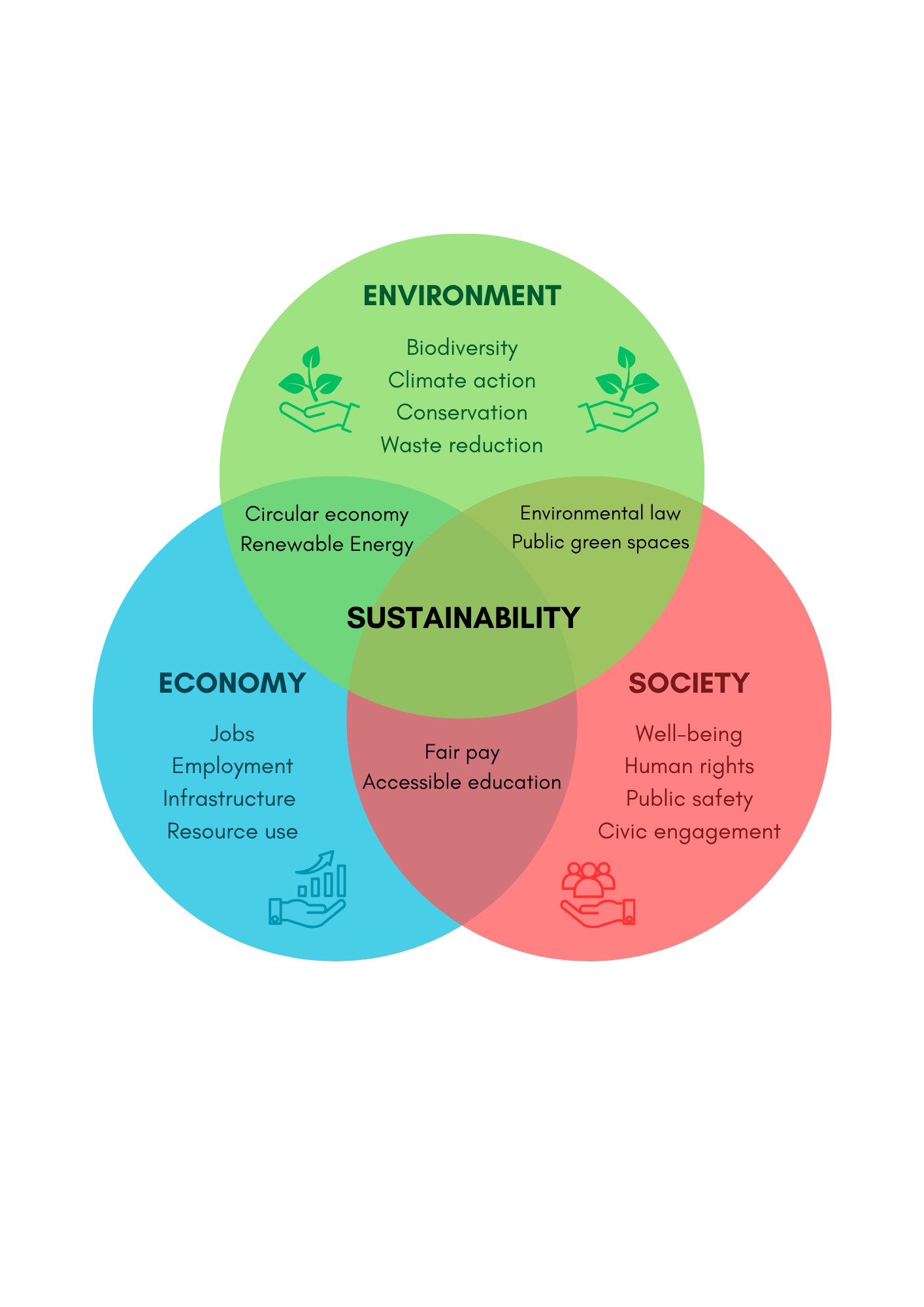
Figure 1: The three pillars of sustainability (environment, economy, and society) with examples of elements, issues, and actions for each pillar and intersection. Diagram by Johann Lawrence Ang, using information from [3].
Viewing sustainability through an environmental lens overlooks challenges such as poverty and gender inequality [4]. These interconnected issues are explicitly targeted by the UN’s Sustainable Development Goals, which promote action on global issues not typically associated with the environment but are imperative for a sustainable world [4].
Solving complex global problems necessitates an integrated approach that spans multiple fields of study. Thus, sustainable development requires tackling issues within an interdisciplinary framework, as no single area of study holds all the answers. If these challenges were addressed in isolation, they would fail to capture the problem fully. For example, scientists, economists, and policymakers are needed to inform legislation that balances economic development with the climate negatives of dairy farming, and the farmers’ livelihoods. By integrating numerous perspectives, sustainability shifts from a vague buzzword into a strategy that protects more than just the environment.
What is the SUSTAIN module?
While global definitions and principles provide the theory, true sustainability relies on application and agency. Educational institutions play an important role in teaching students how to navigate the complex, interdisciplinary challenges of sustainability. At the University of Auckland (UoA), academic knowledge of sustainability is translated into practical action through the SUSTAIN module.
The SUSTAIN module comprises three courses (SUSTAIN 100G, 200, and 300) available to all students, regardless of their degree. Niki Harré, Joseph Fagan, and Manuel Vallee began the course in 2019 to teach students how sustainability relates to them, exploring how personal values, ethics, and motivations shape our connection to the environment and ways to act on them. Currently led by Dr Anthony Gampell and Joseph Fagan, the module has continued its student-centred model. Unlike traditional courses that rely on rigid tests, SUSTAIN’s lectures and coursework prioritise flexibility and creative freedom, allowing students to explore diverse solutions to confront various environmental, economic, and social problems. While the courses have been structured to be accessible to all students (i.e., no course-specific prerequisites are required to take any of the classes), the core ideas of interdisciplinary problem-solving, systems thinking, and individual citizenship run throughout the module.
Gampell says that the SUSTAIN module is designed to provide a foundation for students to address real-world issues at a personal, regional, or global level. Thus, SUSTAIN is not merely about delivering information. SUSTAIN expertly balances a social scientific perspective with STEM to inspire individuals to take action against real-world problems, including issues beyond sustainability.
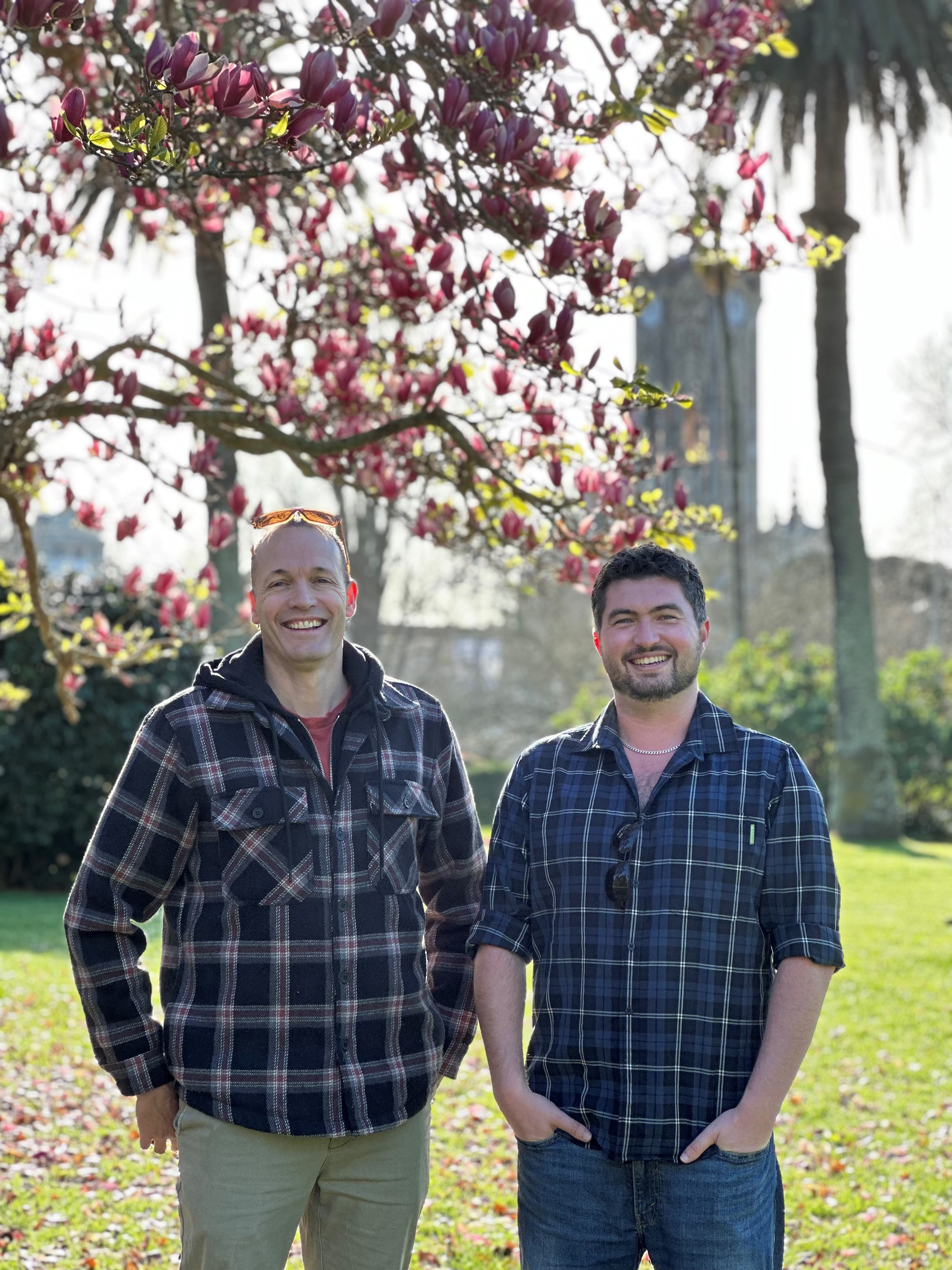
Figure 2: The SUSTAIN module’s course directors, Joseph Fagan (left) and Anthony Gampell (right). Photo from @uoa_sustainable_alliance on Instagram. Photo from Anthony Gampell.
STEM as an Engine
While sustainability recognises the environmental, economic, and social boundaries, STEM can provide the practicality needed to operate within them. Sustainability-based issues are inherently complex and thus often cannot be solved without empirical data to establish baselines, technological innovation to develop solutions, and infrastructure for implementation.
For example, without climate science, we would not have the data to predict temperature increases, sea-level rise, and ecosystem degradation. Technology helps create actionable systems such as satellite monitoring to track island planform change across time, or models to gauge the spectrum of environmental change [5]. Engineering designs physical, resilient solutions, with modern infrastructure moving away from hard, inflexible defences. Finally, mathematics can validate a solution’s capability, progress, and efficiency, providing data on effectiveness and areas for improvement.
Ultimately, STEM tells us what is happening, why it is happening, and the tools to help solve the issue. Beyond a scientific perspective, STEM being an engine for sustainable development is important for social equity and economic viability, as the solutions and infrastructure it creates have far-reaching impacts [6]. In turn, sustainability has helped STEM to move away from extractive designs that cause long-term environmental degradation towards regenerative, circular practices that encourage systems to flourish [6].
SUSTAIN and STEM: Actionable Citizenship
Real-world impact requires more than traditional assessments like tests and essays; fostering genuine student agency and citizenship is core to advancing sustainable development. As such, a novel assignment within the SUSTAIN module is the SUSTAIN Citizenship Passport. After realising that orthodox academic processes do not automatically translate into living sustainably or align with what their lectures promote, Fagan proposed replacing exam weightings with evidence of sustainable actions. Gampell built on this by creating the physical ‘passport’ activity, in which students reflect on and creatively express their learning before further discussing it at ‘border control’ at the end of the semester. The passports are assessed on genuine participation and effort rather than on how well something is written.
Students are provided with a range of options (worth varying points), including growing a plant, volunteering, or writing a UoA Scientific article, with the core goal of having students take sustainability-based actions and think critically about them. For example, the volunteering events students can sign up to often include planting native trees, catchment restoration, and community stream clean-ups. Thus, the Citizenship Passport encourages students to take action and see how their efforts can make a difference on a larger scale. Critically, the passport bridges the gap between the scientific theory students learn and the personal agency the lecturers encourage.
SUSTAIN and STEM: Campus Implementation
As part of the SUSTAIN module’s goal of making sustainability more actionable for students, a systems thinking approach is taught as a core concept. Systems thinking is a mindset that examines how individual components fit within and interact with a larger framework [7]. Crucially, it moves away from seeing inorganic materialisms as separate, emphasises the interconnectedness of systems, and in an environmental context, de-centres the human perspective to include both living and non-living things [7]. Using this framework further encourages interdisciplinary teamwork, allowing students to integrate diverse perspectives and skills.
Rather than studying sustainability as a theoretical concept, the SUSTAIN module will, from 2027, use a Vertically Integrated Project (cutting across SUSTAIN 100G, 200, and 300) to solve UoA campus issues. Firstly, SUSTAIN 100G students will begin by analysing and collecting data on the campus experience from their own, or marginalised perspectives. Secondly, SUSTAIN 200 students will transform that data into a potential solution. Finally, SUSTAIN 300 students will draft and propose an implementation plan.
By connecting the courses, students do not just write hypothetical essays or develop solutions that lack traction; they have the opportunity to speak directly with UoA staff to pitch feasible, data-backed operational changes. Thus, the Vertically Integrated Project will demonstrate how analytical science and interdisciplinary work together to turn observations into tangible alterations.
How successful has the SUSTAIN module been?
For a module that explicitly moves away from a traditional structure, how do Gampell and Fagan measure the success of the module? Traditionally, STEM measures success through easily quantifiable metrics like key performance indicators or test scores. While these metrics are important in industry, the course directors measure the ultimate success of the SUSTAIN module by how graduates embed sustainability and its principles in their careers.
Alumni from the SUSTAIN module have taken what they have learned and applied it to a wide array of sectors. From catchment conservation to corporate banking to government policy-making, former students have continued to consider sustainable development in their everyday lives. Furthermore, with growing interest in sustainability after the module, more and more students have become interested in sustainability as a postgraduate research topic. As a relatively young module, it has achieved remarkable success and could open opportunities for broader study pathways in sustainability.
The SUSTAIN module equips students across all disciplines to recognise potential sustainable developments in their own fields, thereby creating long-term institutional and societal change.
Conclusion
At its heart, the SUSTAIN module redefines sustainability from a vague buzzword into an active, lifelong practice. Through SUSTAIN 100G, 200, and 300, Gampell and Fagan have demonstrated that while STEM provides the tools to understand and address global challenges, long-term solutions require an interdisciplinary mix of minds, systems thinking, and personal responsibility.
Fagan has put it simply as “doing more with less”, which ultimately means “creating relationships and systems that allow human and more-than-human life to continue to flourish.” While there is no doubt of the connection between sustainability and STEM, inherent in it are people’s own values and morals that motivate them to act.
From actionable work through the Citizenship Passport to proposing feasible solutions at UoA, to implementing changes in the workforce, SUSTAIN emphasises the importance of every discipline’s role in building a brighter future.
So, what is sustainability? It is action. It is implementation. It is doing something because you care.
[1] World Commission on Environment and Development, “Our Common Future,” United Nations, 1987. [Online]. Available: http://www.un-documents.net/our-common-future.pdf
[2] United Nations, “Report of the United Nations Conference on Environment and Development,” United Nations. [Online]. Available: https://docs.un.org/en/A/CONF.151/26/Rev.1%28vol.I%29
[3] J. Mensah, “Sustainable Development: Meaning, History, Principles, Pillars, and Implications for Human Action: Literature Review,” Cogent Social Sciences, vol. 5, no. 1, pp. 1–21, 2019, doi: 10.1080/23311886.2019.1653531.
[4] United Nations, “The 17 Sustainable Development Goals,” 2015. [Online]. Available: https://sdgs.un.org/goals
[5] P. S. Kench, M. Sengupta, M. R. Ford, and S. D Owen, “Island Change Framework Defines Dominant Modes of Atoll Island Dynamics in Response to Environmental Change,” Communications Earth & Environment, vol. 5, no. 1, Oct. 2024, doi: 10.1038/s43247-024-01757-1.
[6] B. Giddings, B. Hopwood, and G. O’Brien, “Environment, Economy and Society: Fitting Them Together Into Sustainable Development,” Sustainable Development, vol. 10, no. 4, pp. 187–196, 2002, doi: 10.1002/sd.199.
[7] J. Bennett, Vibrant Matter: A Political Ecology of Things. Durham: Duke University Press, 2010.

Johann Lawrence Ang- Bachelor of Science, Statistics
Johann is a third-year environmental science and part 2 law student. He is especially interested in environmental law including current litigation cases, global environmental policies, and how science informs decision-makers in Aotearoa.